
Wasps & Stinging Insects
Polistes exclamans / Vespula squamosa
Identification, behavior, health risks, prevention, and professional treatment options for Central Florida residents.
Overview
Central Florida is home to a variety of stinging insects that commonly conflict with human activity. Paper wasps (Polistes exclamans and related species) are the most frequently encountered — they construct open, umbrella-shaped nests beneath roof eaves, inside gutter channels, under deck railings, and within landscape shrubs. Yellow jackets (Vespula squamosa in Florida) are ground- or void-nesters that are significantly more aggressive than paper wasps, particularly in late summer when colonies reach peak size. Bald-faced hornets (Dolichovespula maculata) construct large enclosed paper nests in trees or attached to structures and defend them aggressively within a wide perimeter. Mud daubers — solitary wasps in the family Sphecidae — are common throughout Florida and construct small mud tube nests on exterior walls, under eaves, and inside garages. Unlike social wasps, mud daubers are non-aggressive and rarely sting. Cicada killers (Sphecius speciosus) are very large, intimidating-looking solitary wasps that burrow in dry soil but rarely sting and pose little threat to people. Correct species identification matters before treatment, as management approaches and risk levels differ substantially.
Appearance
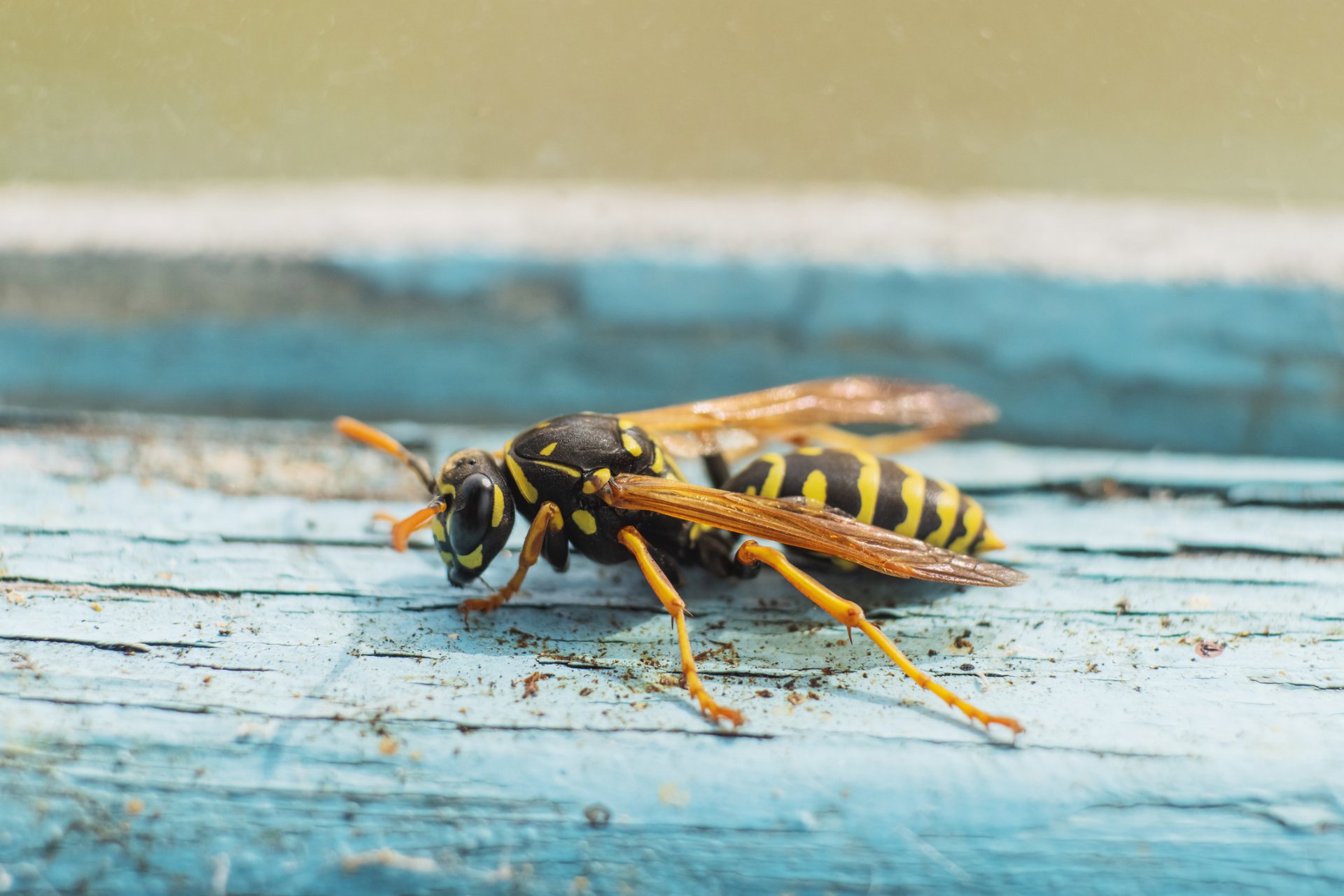
Paper wasps are slender and elongated with narrow waists, brownish-amber bodies with yellow markings, and long dangling legs visible in flight — approximately 5/8 to 3/4 inch long. Yellow jackets are stockier, bright yellow and black with a clearly defined waist, 3/8 to 5/8 inch long, and frequently mistaken for honeybees; unlike honeybees, they are hairless and have a glossy rather than fuzzy appearance. Bald-faced hornets are 5/8 to 3/4 inch, black with white facial and abdominal markings. All three social species can and will sting multiple times; only honeybees die after a single sting.
Behavior & Habits
Paper wasp colonies begin in spring when overwintered queens initiate new nests. Colonies grow through summer, peak in late summer and fall, and die off in winter — queens overwinter in protected harborage to start new nests the following spring. Paper wasps are moderately defensive of the nest but will sting if disturbed. Yellow jacket colonies follow the same seasonal pattern but reach much larger populations (thousands of workers) and are substantially more aggressive; disturbing a yellow jacket nest triggers a mass defensive response. All social wasps are attracted to sweet food and protein during outdoor dining.
Prevention
Inspect eaves, decks, play equipment, and landscape shrubs for early-stage nests in spring and remove them before colonies grow large. Cap hollow fence posts and fill structural voids where yellow jackets can establish void nests. Keep outdoor trash containers tightly sealed. Do not leave sweet beverages unattended during outdoor dining — yellow jackets are drawn to open cans and cups. Treat known problem areas with residual insecticide before nesting season begins in early spring.
Professional Treatment
Small, accessible paper wasp nests can be treated with aerosol wasp spray at dusk when all foragers have returned. Yellow jacket void nests and large paper wasp or hornet nests require professional treatment — the defensive response from a disturbed colony is dangerous without appropriate protective equipment and technique. Professional treatments use dust or aerosol insecticide injected directly into nest openings. GreenCore Environmental handles all stinging insect species with professional equipment, training, and protective gear. Call (866) 816-BUGS to schedule nest removal.
Why Professional Treatment Matters
Florida's climate supports multiple species of wasps and yellow jackets that build paper nests in attic eaves, wall voids, shrubs, and underground burrows year-round. Consumer wasp sprays are effective for small, accessible nests but are dangerous to apply to large nests, nests inside wall voids, or underground yellow jacket colonies — agitated colonies can send hundreds of stinging workers in defense, and nests inside voids cannot be fully treated through the entrance hole with consumer aerosols. Wasp and bee stings are the leading cause of insect-related anaphylaxis deaths in the United States. For individuals with known allergies, a nest near an entry point or recreational area represents a serious medical risk. Professional treatment with proper protective equipment, reaching deep wall-void nests with foam injection, and confirming nest elimination reduces that risk in a way consumer products cannot.
GreenCore Covers Wasps & Stinging Insects
GreenCore technicians treat wasp and yellow jacket nests using appropriate protective equipment and application method for the nest type: aerosol knockdown followed by nest removal for accessible paper nests; foam injection through the entrance for wall-void or eave-cavity nests; and granular or liquid drench for underground yellow jacket colonies. Treatment is performed in the early morning or late evening when foragers are inside the nest and the colony is less defensive. Large nests are photographed and documented before treatment. Follow-up inspection confirms nest inactivity and identifies any secondary nests in the area. Structural repairs (sealing eave gaps that attracted nesting) are noted and recommended to the customer.
The GreenCore Guarantee
If you see pest activity between your scheduled service visits, call us. We will return and re-treat at absolutely no additional charge. This guarantee is not a marketing statement — it is built into every plan we offer. We stand behind our work because we are confident in our methods, and we believe that paying for pest control should mean your pest problem is actually solved.
Dealing with Wasps & Stinging Insects?
Contact GreenCore Environmental to schedule a free inspection. Our licensed technicians serve Central Florida homes and businesses throughout Orange, Osceola, Polk, and Seminole counties.