
Sugar Ants
Brachymyrmex patagonicus
Identification, behavior, health risks, prevention, and professional treatment options for Central Florida residents.
Overview
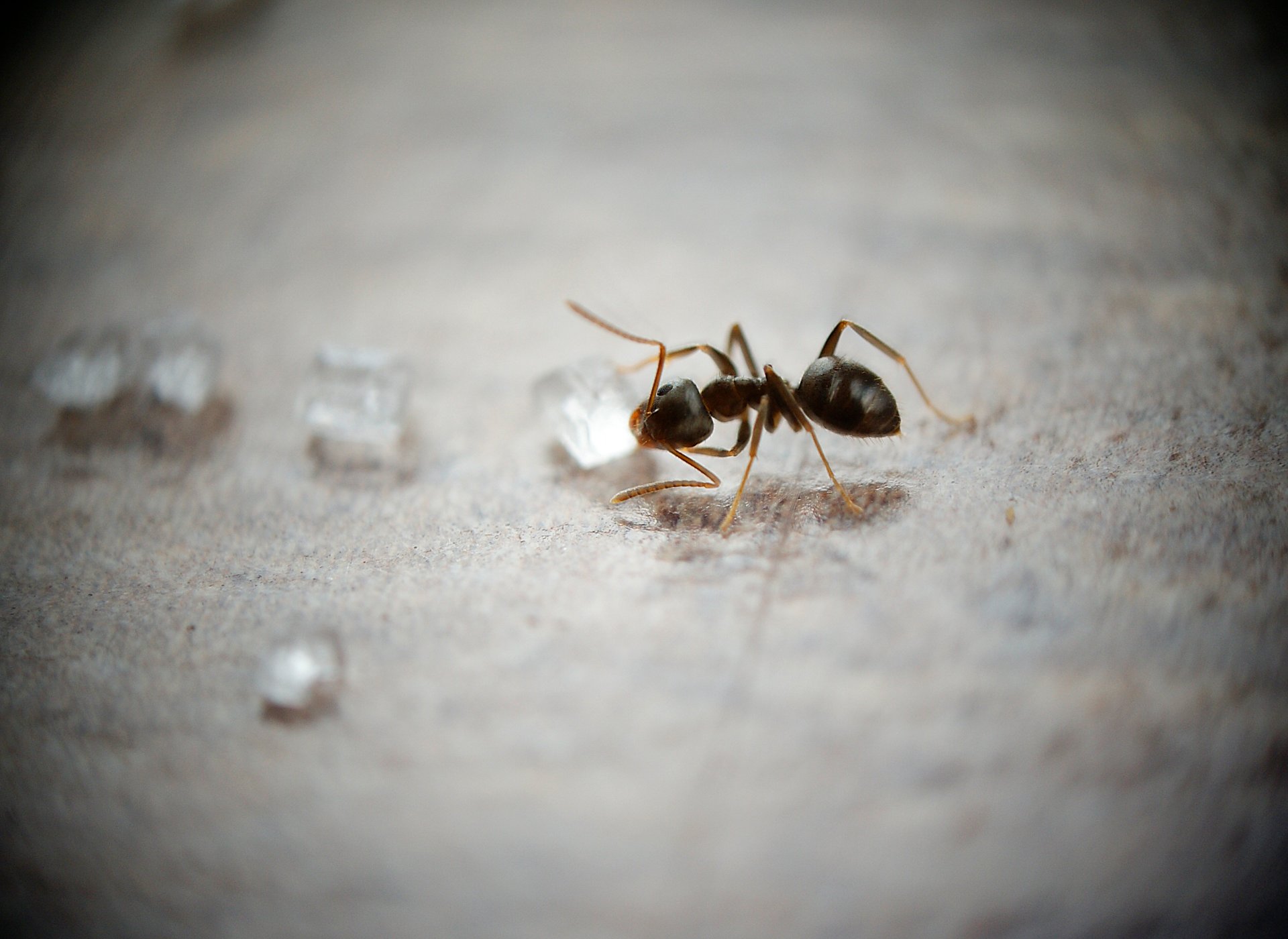
In Central Florida, the term "sugar ants" is applied loosely to several small ant species that invade homes in search of sweet foods and moisture. The most common is Brachymyrmex patagonicus, the dark rover ant — a species introduced from South America that has spread aggressively across Florida over the past two decades. Other species colloquially called sugar ants include ghost ants, Caribbean crazy ants, and occasionally fire ant scouts. All share a preference for sweet liquid food sources, small body size, and a tendency to trail-forage indoors. Sugar ants are one of the most common interior ant complaints in Central Florida homes. They exploit the smallest entry points — door sweeps, window weep holes, plumbing penetrations — and once a foraging trail is established, workers communicate via pheromones to bring hundreds of nestmates to a food source within hours. They are opportunistic and will forage in kitchens, bathrooms, pantries, and any space where moisture or sweet residue is present.
Appearance
Brachymyrmex patagonicus workers are uniformly dark brown to black and very small — approximately 1/16 inch in length, among the smallest ants you will encounter indoors in Florida. Their small size allows them to enter through gaps that larger ants cannot exploit. They have a rounded thorax without spines and antennae with nine segments. The small, uniform, dark coloration distinguishes them from ghost ants (which have pale legs and gasters), fire ants (which are larger and reddish-brown), and carpenter ants (which are significantly larger).
Behavior & Habits
Sugar ants are primarily nocturnal foragers but will trail actively during the day when food sources are abundant. They nest in soil outdoors, under mulch, under objects on the ground, and within wall voids near moisture sources. Indoor nests typically form in wall voids near bathrooms, kitchens, and utility penetrations. A single colony can have multiple queens and hundreds of thousands of workers, and colonies reproduce by budding — a satellite colony breaks off with workers and queens to establish a new nest — which makes baiting essential; spraying alone disperses colonies deeper without eliminating them.
Prevention
Store all sweet foods, syrups, honey, and juices in sealed containers. Repair leaking pipes and faucets — sugar ants seek moisture as much as food. Seal door sweeps, window weep holes, and plumbing penetrations with caulk. Keep counter and sink areas dry between uses. Move mulch beds at least 12 inches away from the foundation, as mulch retains moisture and provides nesting conditions immediately adjacent to the structure.
Professional Treatment
Sugar ants are most effectively controlled with slow-acting gel or granular bait products placed along foraging trails. Workers carry the bait back to the nest and share it with queens and larvae, killing the colony from within over 3–7 days. Residual liquid sprays applied to the exterior perimeter supplement bait by reducing forager populations entering from outside. Do not spray foraging trails with repellent products before bait is established — repellent sprays disperse the colony and scatter satellite nests, making the problem worse. GreenCore Environmental includes sugar ant treatment in our recurring pest control service. Call (866) 816-BUGS to schedule a property evaluation.
Why Professional Treatment Matters
"Sugar ants" in Florida typically refers to several small trailing ant species including Pavement Ants and Argentine Ants that invade kitchens and bathrooms following scent trails to food and moisture sources. Consumer contact sprays and retail bait stations are minimally effective because they don't interrupt the underlying colony — Florida trailing ant species maintain large colony populations that can send replacement foragers immediately after surface workers are killed. Argentine ants, common in Central Florida, form "supercolonies" spanning multiple properties with thousands of queens, making individual colony elimination essentially impossible. The goal of professional treatment shifts to exclusion and suppression — eliminating interior trails, blocking entry points, and applying perimeter treatment that keeps population levels below the threshold of interior invasion.
GreenCore Covers Sugar Ants
GreenCore's trailing ant service begins with an interior inspection to identify active trails and entry points, followed by targeted interior gel bait placement at trail intercept points. Exterior perimeter treatment with a non-repellent liquid creates a transfer-effect zone that ants cross and carry back to colony sites near the structure. Door sweeps and foundation gap sealing are recommended to reduce ongoing entry. GreenCore's approach avoids repellent perimeter sprays that push ants to alternate entry points without reducing colony population. Recurring quarterly service maintains the perimeter treatment barrier and re-treats any new interior activity.
The GreenCore Guarantee
If you see pest activity between your scheduled service visits, call us. We will return and re-treat at absolutely no additional charge. This guarantee is not a marketing statement — it is built into every plan we offer. We stand behind our work because we are confident in our methods, and we believe that paying for pest control should mean your pest problem is actually solved.
Dealing with Sugar Ants?
Contact GreenCore Environmental to schedule a free inspection. Our licensed technicians serve Central Florida homes and businesses throughout Orange, Osceola, Polk, and Seminole counties.