Subterranean Termite
Reticulitermes flavipes / Coptotermes formosanus
Identification, behavior, health risks, prevention, and professional treatment options for Central Florida residents.
Overview
Subterranean termites are the most destructive wood-destroying insects in North America, and Florida has some of the most intense subterranean termite pressure in the entire continental United States. The state's warm temperatures, high rainfall, and year-round soil moisture create near-ideal conditions for multiple subterranean termite species — and unlike in colder climates, Florida homeowners face active termite pressure in every month of the year with no seasonal break. Two species are most significant in Central Florida. The Eastern Subterranean Termite (Reticulitermes flavipes) is the most widespread termite species in North America and the primary subterranean species across much of the state. The Formosan Subterranean Termite (Coptotermes formosanus) is an invasive species from East Asia now established throughout coastal and central Florida, and is widely considered among the most aggressive and destructive termite species in the world. A mature Formosan colony can contain several million workers and consume approximately one pound of wood per day. **The Hidden Damage Problem** The critical distinction between subterranean termites and visible pest insects is that they feed from within, entirely hidden. Colonies live underground. Workers travel to wood sources through soil tunnels and construct mud tubes across exposed surfaces to reach structural wood, feeding on the inside of framing members while leaving a thin surface layer intact. This means the damage accumulates entirely concealed — inside floor joists, behind wall sheathing, within door and window frames — often for years before it becomes visible as hollow-sounding wood, buckling floors, or warped door frames. By the time damage is apparent, significant structural compromise has typically already occurred. The USDA estimates subterranean termites cause over $2 billion in property damage annually in the United States, the vast majority of which is excluded from standard homeowner's insurance policies. **Florida's Termite Density** Florida averages three to five active subterranean termite colonies per acre — and in many urban and suburban areas the density is substantially higher. Formosan subterranean termites can forage up to 100 meters from their colony center, meaning termites in municipal soil or on neighboring properties can infest your home with no obvious source on your own lot. Slab-on-grade construction — standard in Florida due to the state's high water table — gives termites direct access to wooden framing above through expansion joints, utility penetrations, and slab cracks.
Appearance
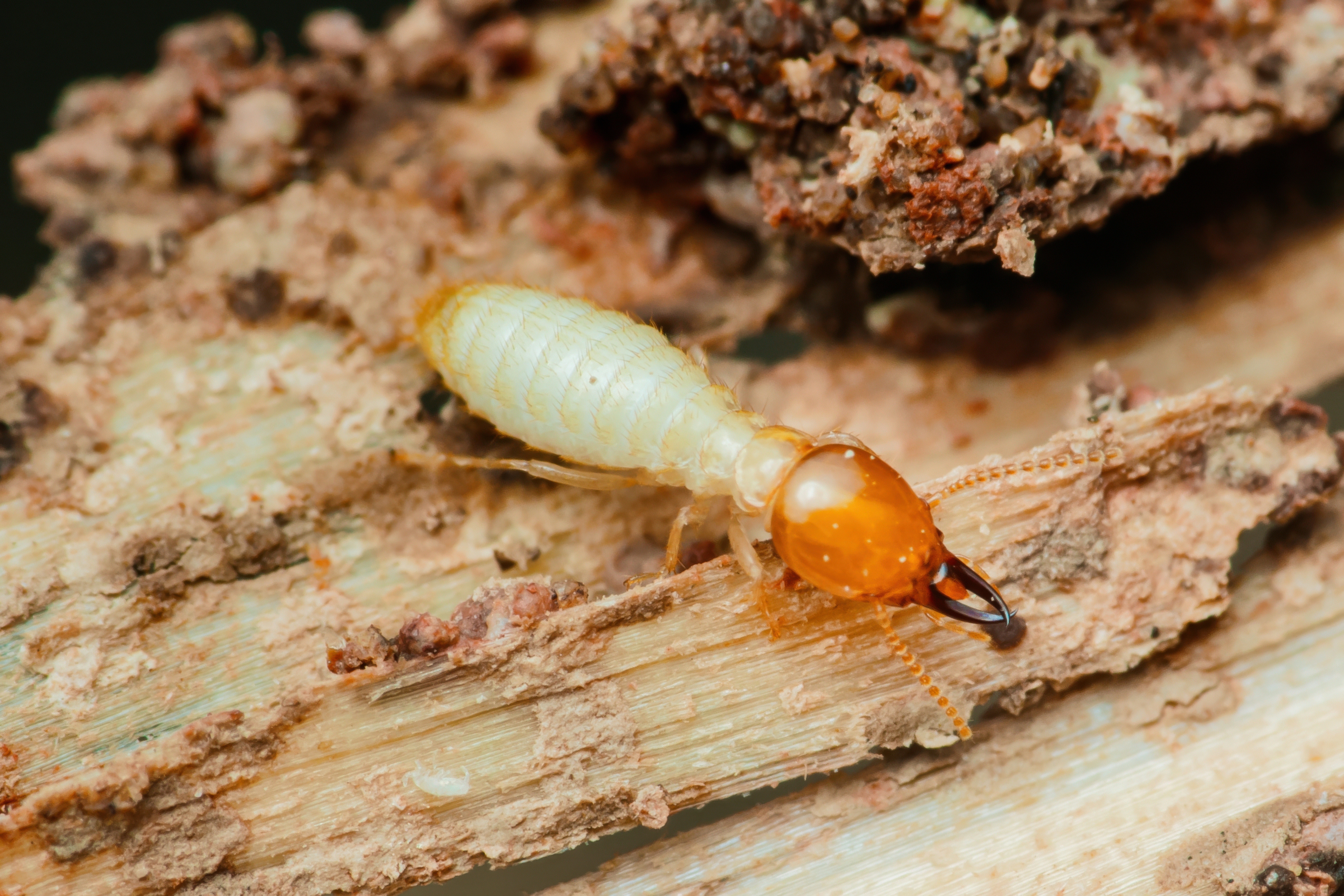
Subterranean termite colonies contain distinct castes. Workers — responsible for all feeding damage — are small (about ⅛ inch), soft-bodied, and creamy white. They are never visible in the open; they remain completely concealed within wood galleries or mud tubes at all times. Soldiers have similarly sized bodies but with enlarged, rectangular heads and large mandibles used in colony defense. Swarmers (alates) are the caste most commonly encountered by homeowners. They are ¼ to ⅜ inch long, dark brown to black, with two pairs of equal-length wings that extend well past the body and are shed shortly after the swarming flight. Formosan swarmers are slightly larger — approximately ½ inch — and yellowish-brown with distinctively hairy wings. Termites are frequently confused with flying ants. Key differences: termites have straight, bead-like antennae while ants have elbowed antennae; termite wings are two equal pairs while ant wings are unequal; and termites have a broad waist between thorax and abdomen while ants have a narrow pinched waist. Mud tubes — pencil-width earthen tunnels running along foundation walls, over concrete, or across exposed surfaces between soil and wood — are the most accessible visual indicator of subterranean termite activity.
Behavior & Habits
Subterranean termite colonies are centered underground around a reproductive queen and king. Worker termites travel from the underground colony through soil tunnels and construct mud tubes across exposed surfaces to reach wood. These tubes maintain the high humidity termites require for survival — they desiccate and die within hours when exposed to open air or direct sunlight. Workers forage continuously — 24 hours a day, every day of the year — consuming the soft spring wood of structural lumber while leaving the harder summer wood intact. This creates hollow galleries inside structural members that may be entirely invisible from the exterior for years. Swarming occurs when a colony has reached sufficient size to produce reproductive alates. In Central Florida, Eastern Subterranean Termites typically swarm from late January through April, often following rain events. Formosan termites swarm from April through July, typically at dusk in warm, humid weather. Swarmers seen indoors near windows or light fixtures are strong evidence of an active colony within or immediately adjacent to the structure.
Prevention
Eliminating wood-to-soil contact is the single most important step in reducing subterranean termite risk. Keep wooden structural elements — siding, door and window frames, deck framing, fence posts — a minimum of 6 inches above soil grade. Remove ground-contact wood from around the structure: buried form boards left from construction, old stumps, scrap lumber stacked against the foundation, and landscape timbers in contact with moist soil. Manage moisture at and around the foundation. Fix roof leaks and plumbing leaks promptly. Maintain gutters and ensure downspout extensions direct runoff away from the foundation. Keep mulch beds thin and pulled back from the foundation — deep, moist mulch creates a continuous organic bridge between soil and wood framing that termites readily exploit. Inspect your foundation perimeter twice a year, specifically looking for mud tubes. Check expansion joints, utility penetrations through the slab, weep holes, and areas where exterior finishes meet the foundation. Mud tubes can be as narrow as a pencil and are easily missed without a deliberate inspection. These measures meaningfully reduce risk but cannot eliminate it for Central Florida properties given the region's termite density. Professional monitoring and active treatment programs are the standard of care.
Professional Treatment
Subterranean termite treatment uses either liquid termiticide soil treatments or baiting systems. Liquid termiticide treatments create a chemical zone in the soil around and beneath the structure. Application typically requires drilling through concrete to treat soil beneath slabs at regular intervals. These treatments are effective when thoroughly applied but degrade over time and do not eliminate the colony. Termite baiting systems — such as Sentricon Always Active, which uses an active ingredient that disrupts the termite molting process — work by having foraging worker termites discover and feed on bait stations installed in the soil around the property. Workers carry the active ingredient back to the colony, where it spreads through the population to reach the queen and eliminate the entire colony over time. Baiting systems provide continuous monitoring and ongoing protection. Given Central Florida's termite density and the high cost of structural remediation — termite damage repair can easily reach five figures and is rarely covered by homeowner's insurance — the investment in professional termite protection is straightforward to justify. Annual inspections are standard practice for Florida homeowners. Contact GreenCore Environmental at (866) 816-BUGS for termite inspection and protection throughout Central Florida.
Why Professional Treatment Matters
Subterranean termites are the single most destructive insect pest in the United States, and Florida has the highest termite pressure of any state in the continental U.S. Reticulitermes and Coptotermes species colonies can contain hundreds of thousands to millions of workers that forage continuously through soil to find cellulose in structural wood, subfloor framing, and wall studs. Consumer termiticide products sold at hardware stores do not create the continuous chemical barrier in soil that licensed termiticide application provides, and they cannot reach the foraging tunnels that extend meters below grade. Delaying professional treatment is expensive: the average subterranean termite repair bill in Florida exceeds $3,000, and significant structural damage can accumulate within a single year of active infestation. Early detection and a maintained soil treatment barrier are the only reliable ways to protect a structure.
GreenCore Covers Subterranean Termite
GreenCore treats subterranean termite infestations using a liquid termiticide soil treatment applied to the full perimeter of the structure. Technicians drill through concrete slabs at regular intervals where soil-to-foundation contact exists and inject termiticide to create a continuous treated zone around the building's footprint. Interior foam treatment is applied to active galleries identified in the structure. For ongoing protection, GreenCore offers annual termite monitoring and re-treatment under its termite protection plans. All treatments use non-repellent termiticide chemistry so foraging termites carry the active ingredient back to the colony rather than avoiding the treated zone.
The GreenCore Guarantee
If you see pest activity between your scheduled service visits, call us. We will return and re-treat at absolutely no additional charge. This guarantee is not a marketing statement — it is built into every plan we offer. We stand behind our work because we are confident in our methods, and we believe that paying for pest control should mean your pest problem is actually solved.
Dealing with Subterranean Termite?
Contact GreenCore Environmental to schedule a free inspection. Our licensed technicians serve Central Florida homes and businesses throughout Orange, Osceola, Polk, and Seminole counties.