
Silverfish
Lepisma saccharina
Identification, behavior, health risks, prevention, and professional treatment options for Central Florida residents.
Overview
Silverfish (Lepisma saccharina) are among the most ancient of household insect pests — essentially unchanged over hundreds of millions of years. In Central Florida's humid climate, silverfish thrive particularly well in the persistently moist conditions found in bathrooms, kitchens, laundry rooms, and humid storage areas. They are strictly nocturnal and highly secretive, meaning infestations are typically more extensive than the occasional individual spotted at night suggests. They prefer high humidity (70–90% relative humidity) and moderate temperatures — conditions that describe a significant portion of Florida homes, particularly in areas with inadequate ventilation. Silverfish are primarily a property damage pest rather than a health concern. They consume polysaccharides found in paper, book bindings, wallpaper paste, cardboard, natural textile fibers, and the starch in clothing — causing significant damage to books, documents, stored paper records, wallpaper, and clothing when present in storage areas over extended periods.
Appearance
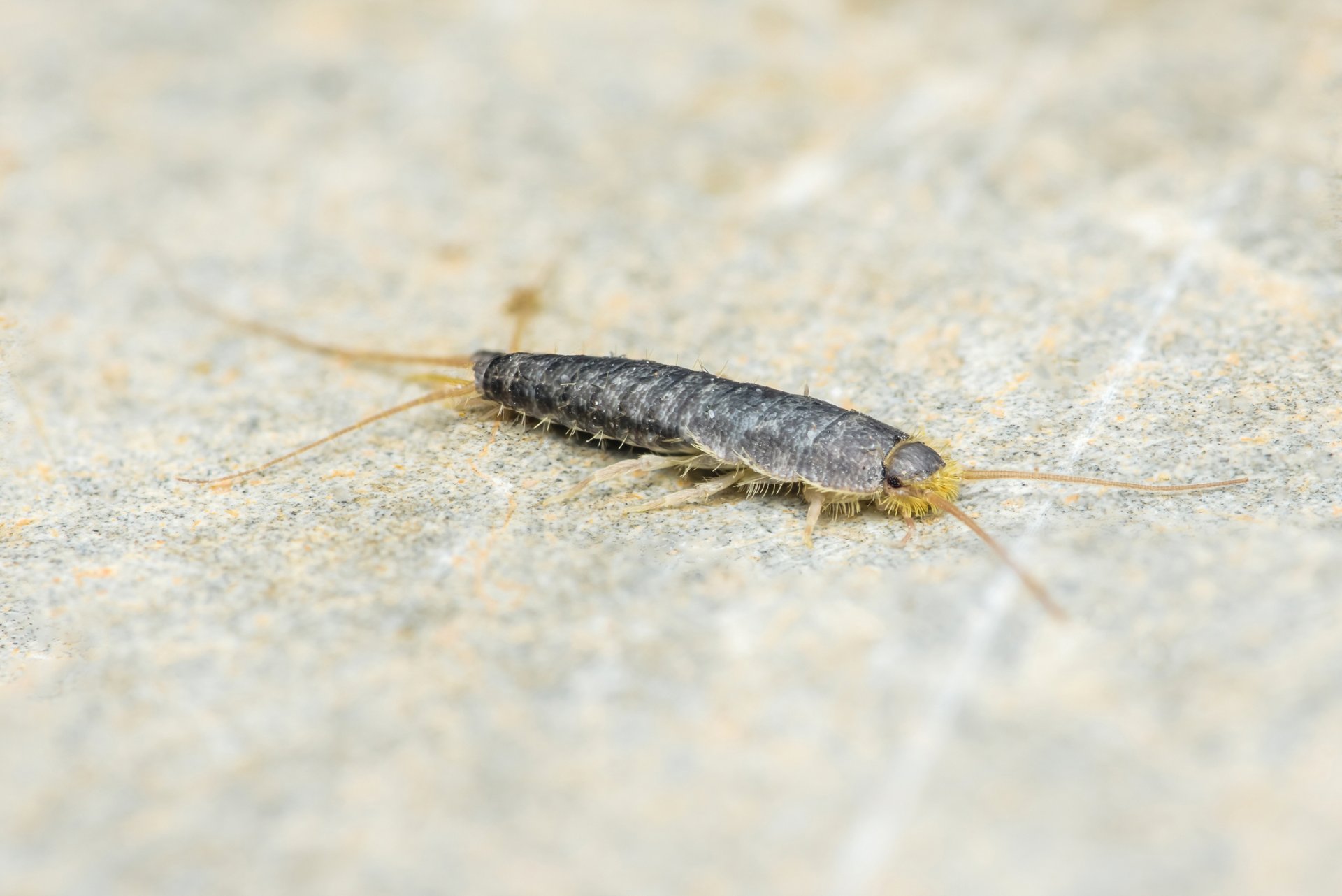
Adult silverfish are 3/8 to 5/8 inch long, elongated, and carrot-shaped — broader at the head end and tapering toward the rear. The body is covered in silvery-gray, iridescent scales that give the insect its name. They have three long, equally spaced tail filaments at the rear and two long antennae at the front. Their movement is a rapid, fish-like wriggling motion. Silverfish are wingless throughout their life. Firebrats are similar in form but are mottled gray-brown rather than silver and prefer hotter, drier environments — around water heaters and furnaces.
Behavior & Habits
Silverfish are fast runners and escape quickly when disturbed in open areas. They seek tight harborage behind baseboards, within stacks of paper or cardboard, under bathroom vanities, in attic insulation, and behind wall panels during daylight hours. They are long-lived for insects — adults survive 2–8 years under favorable conditions — and can survive months without food. Their flat body profile allows them to exploit very tight gaps in trim, flooring, and cabinetry.
Prevention
Reduce indoor humidity by ensuring adequate bathroom and kitchen ventilation and addressing any plumbing leaks. Store paper documents, books, and photographs in sealed plastic containers rather than open cardboard boxes in storage areas. Fix moisture intrusion and high-humidity zones in attics and crawl spaces. Repair deteriorated caulk around tubs, showers, and sinks to eliminate moisture accumulation in wall voids.
Professional Treatment
Silverfish management combines residual insecticide applied to harborage areas — behind baseboards, under sinks, in closet corners, and in attic spaces — with humidity control to make the environment less hospitable. Gel bait products are effective in high-activity areas. Sticky traps identify primary harborage zones and monitor population levels. Professional treatment is most effective when combined with a moisture audit of affected areas. GreenCore Environmental treats silverfish as part of comprehensive pest control service. Call (866) 816-BUGS.
Why Professional Treatment Matters
Silverfish (Lepisma saccharina) are moisture-dependent insects that thrive in Florida's humid climate and can establish large populations in attics, wall voids, and storage areas without ever being detected. They feed on paper, book bindings, cardboard, wallpaper paste, and natural fiber textiles — causing progressive damage to stored documents, books, and clothing over time. Consumer silverfish traps catch individual insects but do not address the colony in attic insulation and wall voids where silverfish lay eggs and shelter. Silverfish populations grow slowly but live for 2–8 years, giving infestations time to reach damaging densities before becoming visible. Moisture control is the foundational step in any silverfish management program — professional treatment combined with a moisture assessment identifies and corrects the conditions driving the infestation.
GreenCore Covers Silverfish
GreenCore technicians inspect attic spaces, interior closets, and wall void areas for silverfish activity and moisture conditions that are sustaining the population. Insecticidal dust is applied to attic cavities, wall void access points, and behind outlet plates where silverfish harbor. Residual liquid treatment is applied to baseboard and closet areas in living spaces. GreenCore identifies and documents moisture sources — roof leaks, HVAC condensation, and inadequate attic ventilation — that create favorable conditions for silverfish, providing customers with a written moisture report. Follow-up treatment addresses any remaining activity and confirms moisture conditions have improved.
The GreenCore Guarantee
If you see pest activity between your scheduled service visits, call us. We will return and re-treat at absolutely no additional charge. This guarantee is not a marketing statement — it is built into every plan we offer. We stand behind our work because we are confident in our methods, and we believe that paying for pest control should mean your pest problem is actually solved.
Dealing with Silverfish?
Contact GreenCore Environmental to schedule a free inspection. Our licensed technicians serve Central Florida homes and businesses throughout Orange, Osceola, Polk, and Seminole counties.