Norway Rats
Rattus norvegicus
Identification, behavior, health risks, prevention, and professional treatment options for Central Florida residents.
Overview
The Norway rat (Rattus norvegicus), also called the brown rat or sewer rat, is the larger of the two rat species commonly found in Florida and the dominant commensal rodent across North America. In Central Florida, Norway rats are less common than roof rats but are present in urban, commercial, and agricultural settings — particularly near waterways, storm drains, refuse areas, and food storage facilities. They thrive in ground-level environments that roof rats avoid, making them the species most associated with sewer systems, crawl spaces, ground-level storage areas, and commercial food service operations. Norway rats are powerful burrowers. Colonies establish underground burrow systems beneath slabs, along fence lines, under sheds, and in dense ground cover. Burrow entrances are typically 2–3 inches in diameter, smooth-edged from repeated use, and often surrounded by loosely scattered soil. Their ground-level habits bring them into contact with crawl spaces and ground-floor interiors more often than roof rats, which prefer elevated harborage.
Appearance
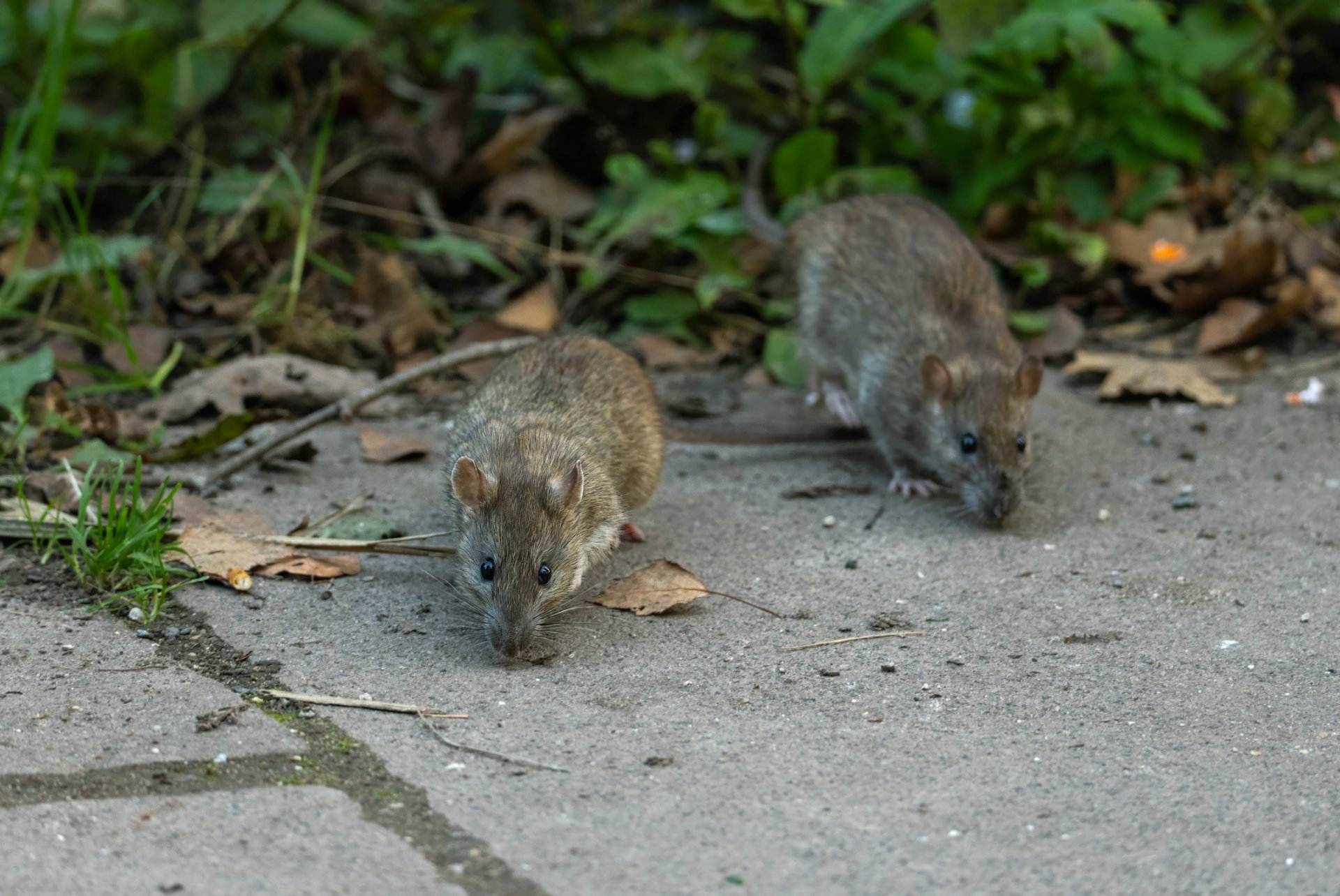
Norway rats are robust and large-bodied — adults weigh 7–18 ounces and measure 12–18 inches from nose to tail tip. The tail is shorter than the combined head and body length (this distinguishes Norway rats from roof rats, whose tails are longer than head plus body). The fur is coarse and typically brownish-gray on the back and lighter gray or white on the underside. The head is blunt and broad, with small eyes and small, close-set ears. Their large size, blunt head, and short tail are the most reliable distinguishing features from roof rats.
Behavior & Habits
Norway rats are neophobic — cautious of new objects in their environment — and establish fixed runways along walls, under equipment, and along fence lines that they use repeatedly. They are primarily nocturnal and are rarely seen during the day unless the infestation is large. They consume 1–2 ounces of food daily and require a water source, which is why infestations concentrate near drains, water lines, and standing water. Gnaw marks, grease rub marks along walls, and burrow entrances near the foundation are common signs of activity.
Prevention
Eliminate food sources by using tight-fitting, rodent-proof containers for garbage and compost. Remove ground-level clutter — stacked wood, debris piles, and dense ground cover within 18 inches of the structure. Seal all exterior openings larger than 1/2 inch with steel wool secured by wire mesh or cement. Repair damaged vent screens, gaps around pipes, and deteriorated door sweeps. Reduce standing water and eliminate conditions that attract Norway rats to the property perimeter.
Professional Treatment
Norway rat control requires exclusion (sealing entry points), habitat modification, and population reduction through snap traps or rodenticide bait stations. Burrow treatment with gas cartridges may be appropriate for severe ground-level infestations. Professional rodent management includes a thorough inspection to map burrow systems and runways, followed by a staged treatment and exclusion program. GreenCore Environmental provides rodent control throughout Central Florida. Call (866) 816-BUGS for an assessment.
Why Professional Treatment Matters
Norway rats (Rattus norvegicus) are burrowing rodents that establish colonies along slab foundations, in crawlspaces, and under landscaping. They are the most common rat species in urban Florida environments and are significantly larger and more aggressive than roof rats. Consumer rodenticide bait blocks can reduce population numbers, but without removing harboring conditions and sealing ground-level entry points, replacement rodents from surrounding territory move in quickly. Norway rats contaminate food storage, spread leptospirosis through their urine, and gnaw through slab penetrations and conduit to enter living spaces. Burrow systems under foundations can destabilize landscaping and create structural concerns over time. Professional rodent control addresses both population and harborage — eliminating the colony and preventing re-colonization.
GreenCore Covers Norway Rats
GreenCore technicians conduct a ground-level inspection to identify Norway rat burrows, gnaw marks at slab penetrations, and landscaping harborage sites. Tamper-resistant bait stations are placed along rat travel routes adjacent to structures and in areas of confirmed burrow activity. Burrow fumigation or collapse is used where active burrowing threatens foundation integrity. Ground-level exclusion — sealing slab penetrations and door gaps — is performed concurrently with population reduction. Follow-up inspections confirm burrow abandonment and treat any new activity sites.
The GreenCore Guarantee
If you see pest activity between your scheduled service visits, call us. We will return and re-treat at absolutely no additional charge. This guarantee is not a marketing statement — it is built into every plan we offer. We stand behind our work because we are confident in our methods, and we believe that paying for pest control should mean your pest problem is actually solved.
Dealing with Norway Rats?
Contact GreenCore Environmental to schedule a free inspection. Our licensed technicians serve Central Florida homes and businesses throughout Orange, Osceola, Polk, and Seminole counties.