
Mosquito
Aedes aegypti / Aedes albopictus
Identification, behavior, health risks, prevention, and professional treatment options for Central Florida residents.
Overview
Florida is home to more than 80 mosquito species, but two — Aedes aegypti (the yellow fever mosquito) and Aedes albopictus (the Asian tiger mosquito) — are responsible for the majority of residential mosquito complaints in Central Florida and represent the most significant public health concerns. These species are daytime biters, breed in very small amounts of standing water, and are capable of transmitting serious diseases. They behave quite differently from the nuisance mosquitoes most people picture when thinking about mosquitoes. Mosquito pressure in Central Florida is effectively year-round. The warm climate and average annual rainfall exceeding 50 inches provide continuous breeding conditions for populations that would be dramatically reduced by winter in colder states. The wet season — approximately June through September — produces peak mosquito populations, but active mosquitoes breed and bite in all months, including during warm spells in January and February. **Why Florida Mosquitoes Are Different** Most people associate mosquitoes with dusk and dawn — large, slow-moving species emerging from ponds and wetlands in the evening. Aedes aegypti and Aedes albopictus operate completely differently. Both are aggressive daytime biters with peak activity in early morning and late afternoon. They are domestic mosquitoes — specifically adapted to human residential environments rather than natural wetlands. They breed in tiny containers: flower pot saucers, clogged gutters, tarps with low spots, birdbaths, children's outdoor toys, bottle caps, and any object that retains even a few tablespoons of water for more than a week. This domestic breeding habit means that mosquito populations on your property are generated almost entirely by conditions on and around your property — not by distant swamps or retention ponds. A single neglected flower pot saucer can produce dozens of adult mosquitoes per week. **Disease Concerns in Florida** Aedes aegypti is a primary vector for dengue fever, Zika virus, chikungunya, and yellow fever. Aedes albopictus transmits dengue, Zika, chikungunya, and Eastern Equine Encephalitis. Florida has experienced documented local transmission of dengue, Zika, and chikungunya — these are not theoretical risks. The Florida Department of Health regularly issues mosquito-borne disease advisories for Central Florida counties, and dengue in particular has seen sustained local transmission in parts of South and Central Florida in recent years. Beyond disease transmission, mosquito bites cause significant discomfort, allergic welting in sensitive individuals, and secondary skin infections from scratching. For families, gardeners, and outdoor workers, heavy mosquito pressure can make outdoor spaces functionally unusable during peak activity hours.
Appearance
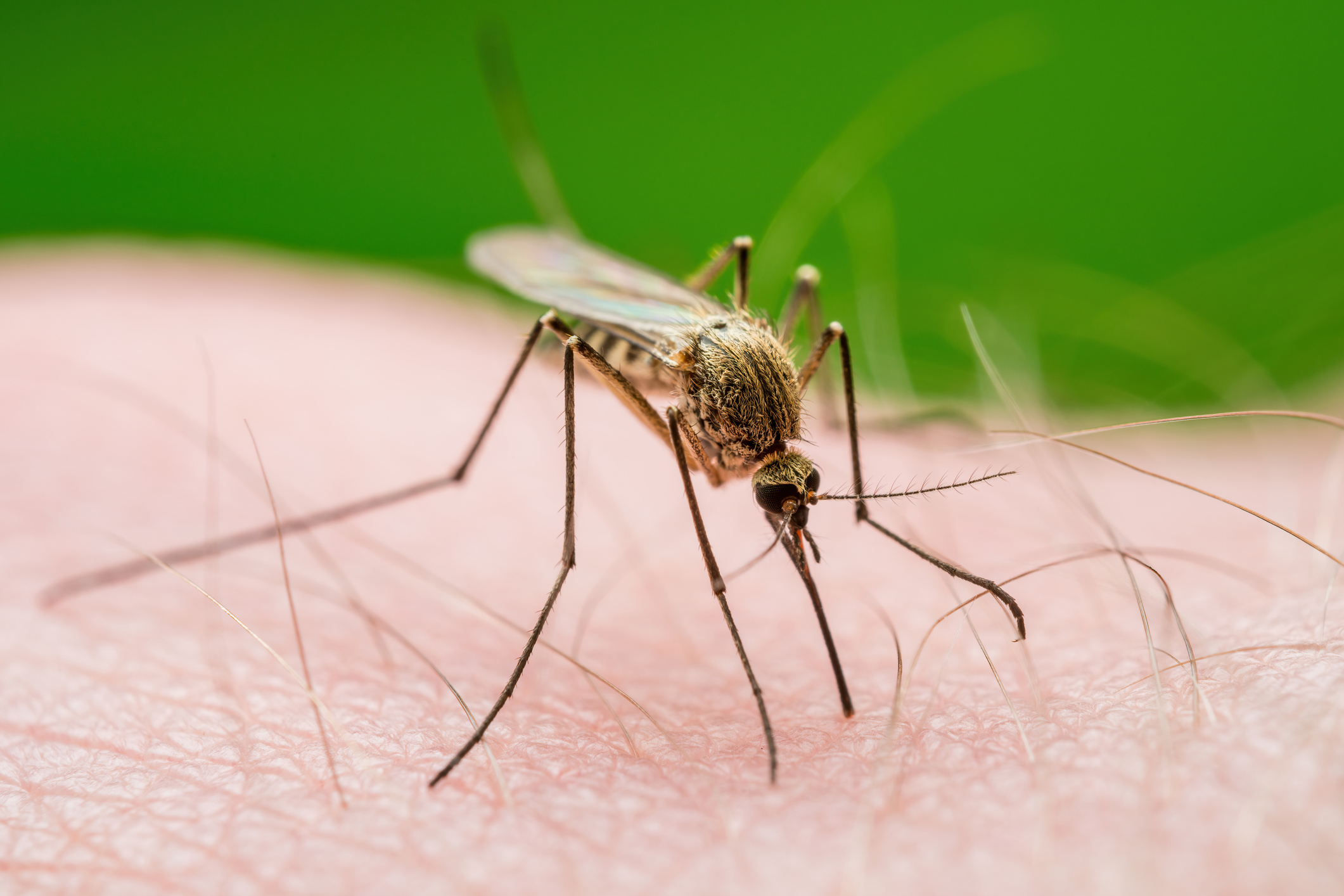
Aedes aegypti is a relatively small mosquito — adults are approximately ¼ inch in length — with distinctive black and white striped markings. The legs are banded black and white, and a characteristic lyre-shaped white marking appears on the thorax (the area behind the head). This lyre marking is the most reliable visual identification feature for Aedes aegypti. The species is often described as the most visually distinctive of Florida's common mosquitoes. Aedes albopictus is similarly small, also black and white, but is distinguished by a single white stripe running straight down the center of the thorax rather than the lyre pattern of Aedes aegypti. Both species hold their bodies roughly parallel to the surface when biting, which distinguishes them from the angled resting posture of Anopheles mosquitoes. Larvae are aquatic, approximately ¼ inch in length, with a large rounded head and a breathing siphon at the posterior end that they hold at the water surface. They drop rapidly to the bottom of the container when disturbed. Pupae are comma-shaped and similarly found at the water surface. The complete life cycle from egg to adult takes as little as 7 to 10 days in warm Florida temperatures — meaning a new breeding container can produce biting adults within a week and a half.
Behavior & Habits
Aedes aegypti is closely tied to human habitation. It rests inside homes and in shaded outdoor areas near the ground, biting primarily during daylight hours with two activity peaks: approximately one to two hours after sunrise and two to three hours before sunset. It is persistently aggressive — returning to bite repeatedly after being brushed away — and preferentially feeds on humans over other animals, making it an efficient disease vector in residential settings. It bites primarily at the ankles and lower legs. Aedes albopictus is more opportunistic in host selection, feeding on humans, birds, and mammals, which can facilitate bridging transmission of diseases between wildlife reservoirs and humans. It is active outdoors in shaded vegetation and around the home's perimeter. Both species have very short flight ranges — they rarely travel more than 150 meters from their breeding site. This is a key biological characteristic: it means that mosquitoes biting you on your property are almost certainly breeding on or very near your property. It makes source reduction — eliminating breeding containers — by far the most effective control strategy available to homeowners, more impactful than any spray treatment for this group. Females require a blood meal before each egg-laying cycle and deposit 100 to 200 eggs per batch, placing them at the waterline on the inner surface of containers rather than on the water surface. Eggs can survive complete desiccation for months, hatching when water returns — which is why eliminating standing water is necessary but not sufficient if egg-bearing containers are not also cleaned or discarded.
Prevention
Eliminating breeding sites is the highest-impact action any homeowner can take against mosquitoes. Walk your property weekly during mosquito season and empty, scrub, or treat every container that holds water. The items most commonly overlooked include flower pot saucers (consistently the single most productive breeding container in Florida residential yards), corrugated roofing scraps, tarps with low points, children's plastic outdoor toys, bottle caps in garden beds, unused ornamental containers, and the hollow centers of cut bamboo or cane. Clean and flush birdbaths and pet water bowls at least twice weekly — mosquito eggs are killed by scrubbing the container walls and refilling with fresh water. Clean gutters seasonally to prevent wet leaf debris from creating pocket breeding sites. Ensure rain barrels and other intentional water storage have tight-fitting screened lids that prevent female mosquitoes from accessing the water surface to lay eggs. Drill drainage holes in outdoor planters that do not drain freely. Remove or invert unused containers — flower pots, buckets, wheelbarrows — so they cannot collect rainwater. Trim back dense vegetation along fences and foundations where adult mosquitoes rest in shade between feeding bouts. For personal protection during outdoor activity, wear light-colored long-sleeved clothing and use EPA-registered repellents containing DEET, picaridin, or oil of lemon eucalyptus. These measures reduce bites but do not reduce the breeding population around the property.
Professional Treatment
Mosquito management uses several complementary tools. Larvicide treatments applied to ornamental water features, drainage areas, and any water that cannot be emptied prevent larvae from completing development into adults. Granular Bacillus thuringiensis israelensis (Bti) — a naturally occurring bacterium that targets mosquito and fungus gnat larvae without affecting other organisms — is appropriate for use in ornamental ponds, birdbaths, and similar features that cannot be emptied. Adulticide treatments applied to resting vegetation — the underside of leaves, shrub understory, shaded ground covers, and other areas where adult mosquitoes harbor between bouts of activity — can significantly reduce adult populations for several weeks after application. Professional applications use residual formulations and target resting sites based on mosquito behavior, which is more effective than broadcast spraying. Recurring barrier spray service — applied monthly through the active mosquito season — maintains reduced adult populations around the property perimeter. No single treatment provides complete mosquito control, because breeding containers can be located on adjacent properties beyond your control, and because highly productive containers are often the ones least visible during casual inspection. A professional property assessment can identify breeding sites and resting harborage that may not be obvious during a self-guided walkthrough. GreenCore Environmental provides mosquito control service throughout Central Florida — call (866) 816-BUGS to schedule a property evaluation.
Why Professional Treatment Matters
Mosquito populations in Central Florida are driven by breeding sites that are often invisible to residents — standing water in bromeliads, clogged gutters, tree holes, and containers holding as little as a bottle cap of water can produce hundreds of mosquitoes per week. Consumer repellents protect individuals temporarily but do not reduce the population breeding on and around the property. Propane-fueled traps and citronella products have been consistently shown in independent research to have minimal effect on overall mosquito abundance. Florida mosquitoes carry West Nile virus, Eastern equine encephalitis, and in certain areas, dengue fever and Zika virus. Aedes aegypti and Aedes albopictus, both active container-breeding species in Florida, are primary vectors. A professional treatment program targets both adult mosquitoes and the larval breeding sites on the property, delivering meaningful reduction in biting pressure rather than just personal protection.
GreenCore Covers Mosquito
GreenCore's mosquito service combines a source reduction inspection with residual barrier treatment. Technicians identify and treat standing water sources with larvicide (BTi — Bacillus thuringiensis israelensis), a biological product that kills mosquito larvae without affecting other wildlife or pollinators. Adult mosquitoes are reduced through residual application to foliage, shrub undersides, and shaded resting areas where adult mosquitoes shelter during daylight hours. GreenCore recommends monthly mosquito service during Florida's peak season (March through November) and offers seasonal programs with the GreenCore Guarantee — if adult mosquito pressure remains unacceptable between visits, GreenCore re-treats at no charge.
The GreenCore Guarantee
If you see pest activity between your scheduled service visits, call us. We will return and re-treat at absolutely no additional charge. This guarantee is not a marketing statement — it is built into every plan we offer. We stand behind our work because we are confident in our methods, and we believe that paying for pest control should mean your pest problem is actually solved.
Dealing with Mosquito?
Contact GreenCore Environmental to schedule a free inspection. Our licensed technicians serve Central Florida homes and businesses throughout Orange, Osceola, Polk, and Seminole counties.