
Mice
Mus musculus
Identification, behavior, health risks, prevention, and professional treatment options for Central Florida residents.
Overview
The house mouse (Mus musculus) is the most widely distributed commensal rodent in the world and a common structural pest in Central Florida homes, businesses, and storage facilities. Mice exploit far smaller entry points than rats — any gap wider than 1/4 inch — and can establish hidden populations inside walls, attics, and sub-floor voids without being noticed for months. They reproduce at an exceptional rate: a single pair can produce 5–10 litters of 5–6 pups annually under favorable conditions, meaning a small initial introduction can become a substantial infestation within weeks. In Central Florida, house mice compete with roof rats and in some cases cohabit the same structure, occupying different voids and food sources. Mice tend to nest closer to food sources and in lower, tighter voids, while roof rats favor attics and elevated harborage. Both species gnaw continuously to wear down their ever-growing incisors, making them a consistent source of wiring, insulation, and material damage.
Appearance
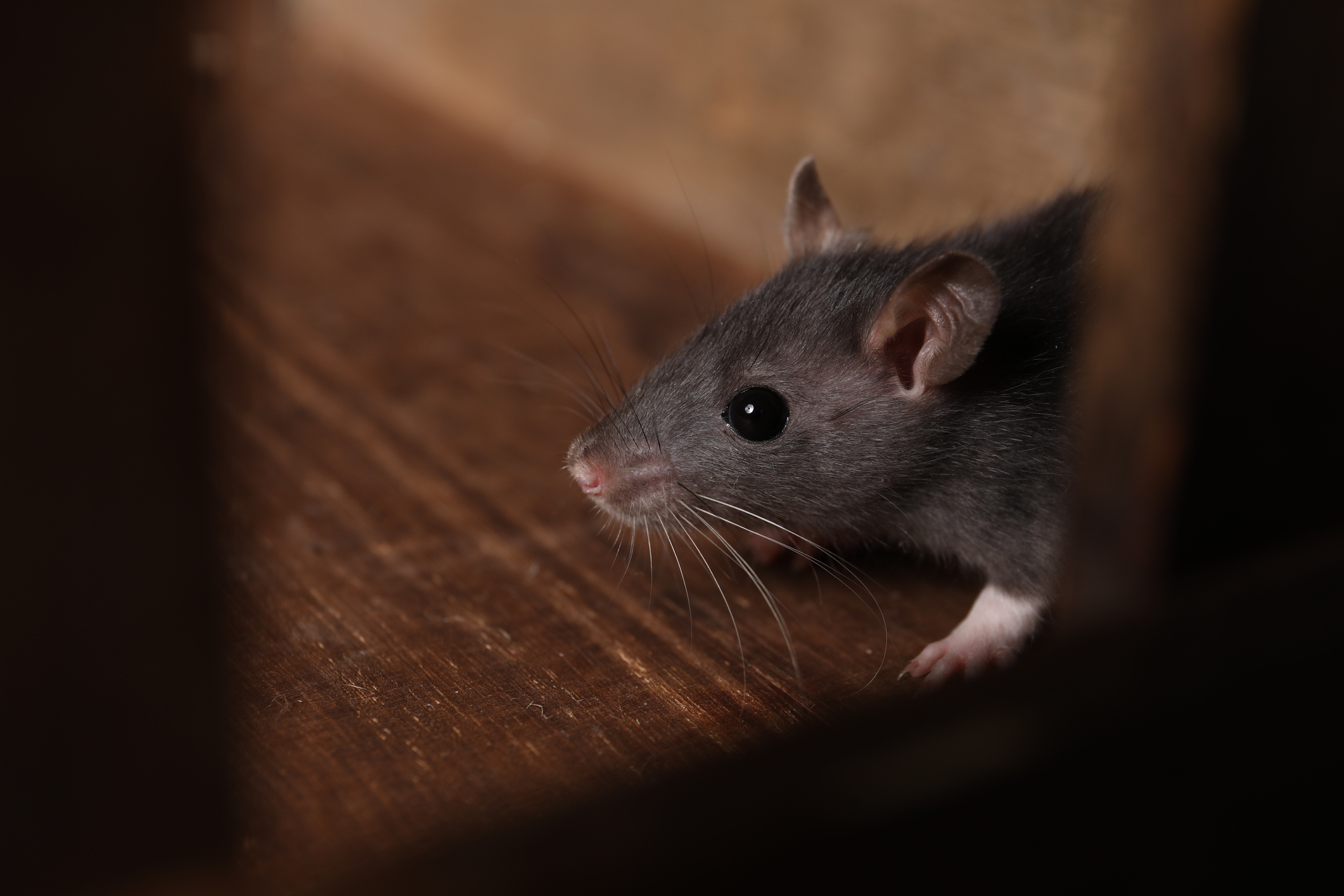
House mice are small — adults are 5–8 inches from nose to tail tip and weigh approximately 1/2 to 1 ounce. The fur is typically light brown to gray-brown with a lighter underside. The tail is approximately as long as the body, lightly haired, and covered in fine scales. The eyes are large relative to body size and the ears are prominent. House mice are distinguished from young roof rats by their relatively larger ears, proportionally larger eyes, and more uniform coloration; young roof rats have distinctly larger hindfeet relative to body size.
Behavior & Habits
Mice are curious by nature — unlike rats, they are much less neophobic and will investigate new objects quickly. They are nibble foragers rather than meal foragers, consuming dozens of small meals throughout the night from different food sources. They can survive on very small quantities of food and obtain sufficient moisture from food alone in environments where free water is scarce. Mice establish small home ranges (10–30 feet from the nest) and leave continuous grease marks and urine droplets along runways near baseboards.
Prevention
Seal all exterior gaps larger than 1/4 inch — mice enter through weep holes, gaps around pipe penetrations, deteriorated door sweeps, and poorly fitted utility panels. Store food in hard-sided sealed containers. Eliminate indoor clutter that provides nesting material. Keep garage floors and storage areas free of cardboard and fabric materials. Inspect incoming boxes and packages for hitchhiker mice, particularly during moves or deliveries from storage facilities.
Professional Treatment
Mouse control combines exclusion, trapping, and sanitation. Snap traps placed perpendicular to walls along established runways are the most effective immediate reduction tool. Rodenticide bait stations are used in areas inaccessible to children and pets. Exclusion — sealing entry points with appropriate materials — is essential to prevent re-infestation from surrounding areas. GreenCore Environmental provides comprehensive rodent control service for Central Florida homes and businesses. Call (866) 816-BUGS to schedule an inspection.
Why Professional Treatment Matters
House mice (Mus musculus) can enter structures through gaps as small as a dime (approximately 6mm), making exclusion by homeowners extremely difficult without a systematic inspection. Consumer snap traps and glue boards capture individual mice but do not address entry points — populations in adjacent landscaping and neighboring structures will continue to replenish an accessible building indefinitely. Mice contaminate food and surfaces with urine and fecal matter and are vectors for Salmonella, hantavirus, and leptospirosis. They gnaw on electrical wiring, HVAC insulation, and stored goods. A single female mouse can produce 5 to 10 litters per year. Early professional intervention stops a small problem before it becomes a large one, and exclusion work creates a lasting barrier that consumer products cannot provide.
GreenCore Covers Mice
GreenCore's mouse control service starts with an interior and exterior exclusion inspection, identifying all gap entry points at foundation level, utility penetrations, door thresholds, and wall voids. Identified gaps are sealed with gnaw-resistant materials. Interior snap traps and tamper-resistant bait stations are placed in wall-void access points and along travel routes identified by dropping evidence. GreenCore does not use open-placement rodenticide inside living spaces. Follow-up service confirms trap activity has ceased and inspects for any new entry points opened by rodent gnawing.
The GreenCore Guarantee
If you see pest activity between your scheduled service visits, call us. We will return and re-treat at absolutely no additional charge. This guarantee is not a marketing statement — it is built into every plan we offer. We stand behind our work because we are confident in our methods, and we believe that paying for pest control should mean your pest problem is actually solved.
Dealing with Mice?
Contact GreenCore Environmental to schedule a free inspection. Our licensed technicians serve Central Florida homes and businesses throughout Orange, Osceola, Polk, and Seminole counties.