
Love Bugs
Plecia nearctica
Identification, behavior, health risks, prevention, and professional treatment options for Central Florida residents.
Overview
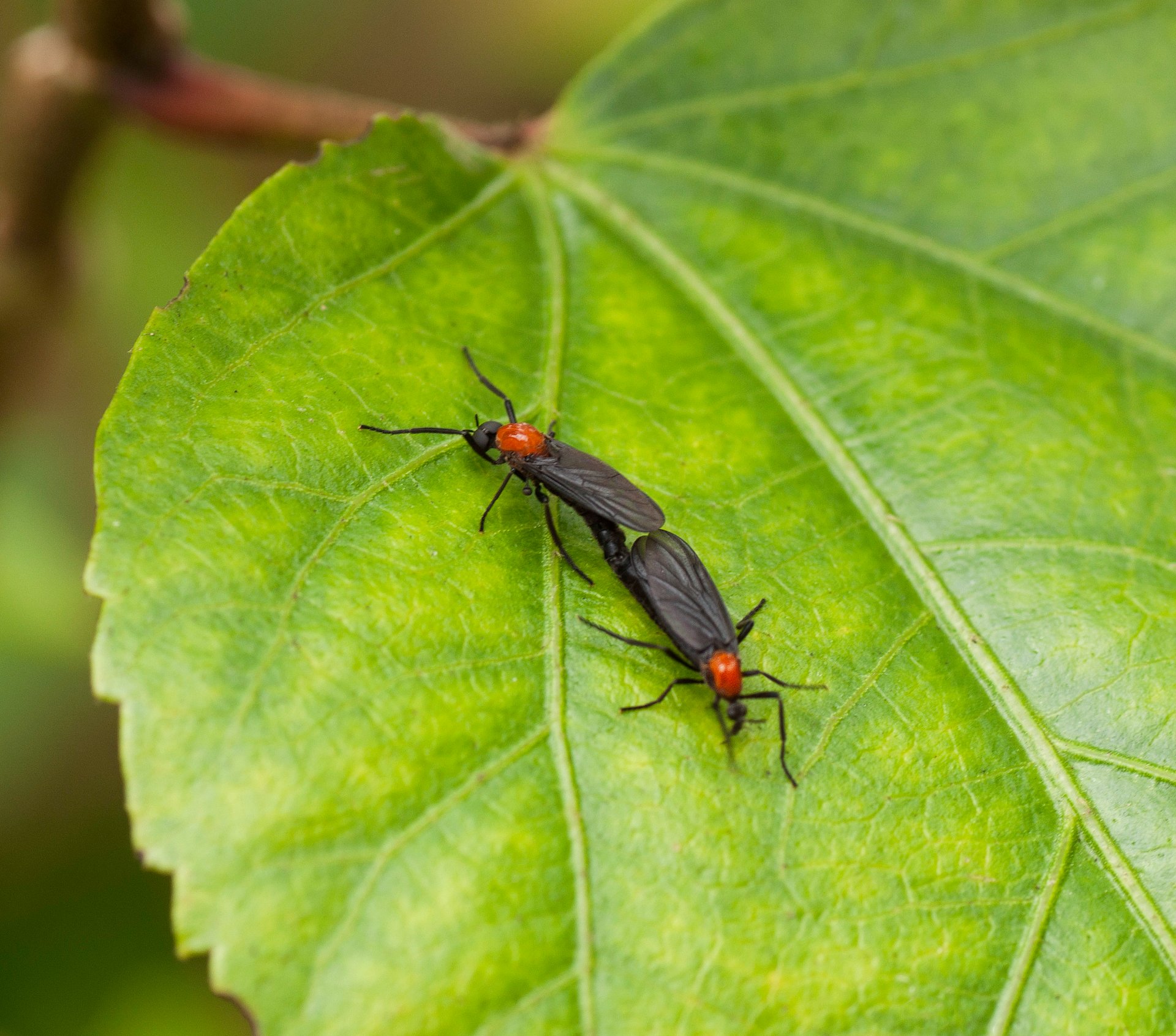
Love bugs (Plecia nearctica) are a uniquely Florida phenomenon — a seasonal nuisance pest with no real equivalent in other states, instantly recognizable by their mating flight behavior and their destructive effect on vehicle paint and radiators. Despite their association with Florida popular culture, love bugs are actually an introduced species native to Central America, first recorded in Florida in the 1940s and now established statewide. Central Florida experiences two major emergence events annually: one in late April through May, and another in August through September, each lasting approximately 4–5 weeks. Love bugs do not bite, sting, or transmit disease and do not infest structures. Their pest status is specific to their flying adult stage and the acidic body chemistry that damages vehicle paint and can clog radiators. The name reflects their flight behavior — adult love bugs fly and rest locked together in copula for up to 12 hours.
Appearance
Adult love bugs are approximately 1/4 to 3/8 inch long (excluding the joined partner). The head, wings, and abdomen are glossy black; the thorax (the segment behind the head) is red-orange. Both sexes appear identical in body shape and size. The characteristic visual is the conjoined mated pair — male and female attached end-to-end — which is the sight familiar to every Florida resident during emergence events. Individual love bugs encountered before or after mating resemble small, slow-flying flies.
Behavior & Habits
Adult love bugs emerge from soil-level pupal cases within a few days of each other in a synchronized mass emergence. After mating in the air, females land to deposit eggs in decaying organic matter — leaf litter, rotting vegetation, lawn thatch — and die shortly after. The larval stage (approximately 5–7 months of soil-level development) is essentially invisible to residents. Adults are attracted to heat, light colors, and vehicle exhaust hydrocarbons, which is why they concentrate heavily on roadways and light-colored vehicles. Peak activity is between 10 AM and 6 PM; activity ceases at night and drops sharply when temperatures fall below 68°F.
Prevention
Apply a coat of car wax before each emergence season — wax creates a protective layer that slows paint etching and makes removal easier. Wash vehicles promptly after accumulation; soak with water before wiping to prevent paint scratching from dried carcasses. Applying a thin layer of baby oil or cooking spray to the hood and front bumper provides a slick surface for easy mass removal. There is no practical way to prevent love bug emergence or flight — seasonal vehicle protection is the realistic management approach.
Professional Treatment
Love bugs are not controllable by conventional pest management. They do not infest structures, do not nest in accessible locations, and spend no meaningful time on treatable surfaces. Perimeter insecticide applications have no effect on airborne swarms. The appropriate response is seasonal awareness and vehicle protection. Love bugs are not controlled with sprays — no treatment meaningfully reduces flights. GreenCore's support during flight events focuses on exclusion, while our recurring perimeter service controls the many other Central Florida pests that are treatable. Call (866) 816-BUGS for comprehensive home pest protection.
Why Professional Treatment Matters
Love bugs (Plecia nearctica) are a seasonal nuisance pest in Central Florida that occurs in two major flight events per year — spring (April–May) and fall (August–September). During flight events, love bugs aggregate in enormous numbers around structures, vehicles, and outdoor lighting, and their bodies and eggs are mildly acidic, damaging vehicle paint when left unremoved. Consumer insecticides are not an appropriate management tool for love bugs — they are beneficial decomposers and blanket spraying has no lasting effect on a regionally distributed population. The primary professional service for love bug events is structural barrier treatment to prevent entry into buildings through gaps around doors, windows, and vents, combined with exterior lighting management guidance to reduce attractant conditions. Understanding that love bug flight events are temporary seasonal phenomena helps set appropriate expectations for management outcomes.
GreenCore Covers Love Bugs
GreenCore's love bug support during flight events focuses on structural exclusion — sealing gaps around entry doors, sliding door tracks, window screens, and exterior vents to prevent love bugs from entering the structure. Exterior perimeter liquid treatment is applied to reduce the number of love bugs resting on wall surfaces and around entry points. GreenCore advises customers on exterior lighting adjustments during peak flight periods (love bugs are attracted to light-colored surfaces and ultraviolet light). Vehicle protection wax application is recommended before flight season. GreenCore does not guarantee elimination of exterior love bug presence during active flight events — the treatment goal is preventing interior entry and reducing surface congregation.
The GreenCore Guarantee
If you see pest activity between your scheduled service visits, call us. We will return and re-treat at absolutely no additional charge. This guarantee is not a marketing statement — it is built into every plan we offer. We stand behind our work because we are confident in our methods, and we believe that paying for pest control should mean your pest problem is actually solved.
Dealing with Love Bugs?
Contact GreenCore Environmental to schedule a free inspection. Our licensed technicians serve Central Florida homes and businesses throughout Orange, Osceola, Polk, and Seminole counties.