
Ghost Ant
Tapinoma melanocephalum
Identification, behavior, health risks, prevention, and professional treatment options for Central Florida residents.
Overview
Ghost ants are one of the most common and consistently frustrating household pest ants in Florida — and one of the species most likely to defeat well-intentioned DIY treatment attempts. Their common name comes from their remarkable translucence: the pale, nearly transparent abdomen and legs make them nearly invisible on white countertops, light-colored walls, and kitchen tile, appearing to materialize from nowhere. Many Florida homeowners spend weeks chasing ants they can barely see before identifying what they are dealing with. Ghost ants are a tropical species native to Africa or Asia, introduced to Florida through the ornamental plant trade. They are now established throughout the state and are particularly abundant in Central Florida, where the warm, humid climate allows them to remain active and reproductive year-round. They are consistently among the top household pest ant complaints received by Florida pest control professionals. **What Makes Ghost Ants So Persistent** Ghost ant colonies are fundamentally different in structure from many other ant species — and this difference is why they are so difficult to control with standard methods. Ghost ant colonies are polydomous, meaning they maintain multiple sub-nests distributed across a landscape or through a structure, all connected by foraging trails and linked by workers who move freely between them. A "colony" of ghost ants in your home is not a single nest that can be found and removed — it is a networked population potentially spanning your kitchen wall void, the soil under a flower pot on the porch, the root zone of a shrub along the foundation, and the gap behind the baseboard in your bathroom. Ghost ant colonies are also polygyne — containing many reproductive queens rather than just one. This means the colony can rapidly replace eliminated queens and can fragment into new sub-colonies when stressed. Applying a repellent insecticide spray to a foraging trail — which is what most consumer ant products do — causes the colony to fragment and spread to new locations in the structure. This is why it is so common for homeowners to report that after spraying, the ghost ant problem "got worse" or "moved somewhere else." **Florida's Ghost Ant Challenge** Florida's climate creates exceptional ghost ant pressure in residential settings. The warm, year-round temperatures allow uninterrupted colony growth. The abundance of indoor tropical plants, kitchen moisture sources, and outdoor landscaping provides both nesting habitat and sustained food sources. Ghost ants exploit the microscopic gaps common in Florida construction: the space between baseboard and flooring, the unsealed penetration where the kitchen drain pipe passes through the cabinet floor, the gap in a sliding door track. Their tiny size makes them capable of using entry points invisible to the naked eye.
Appearance
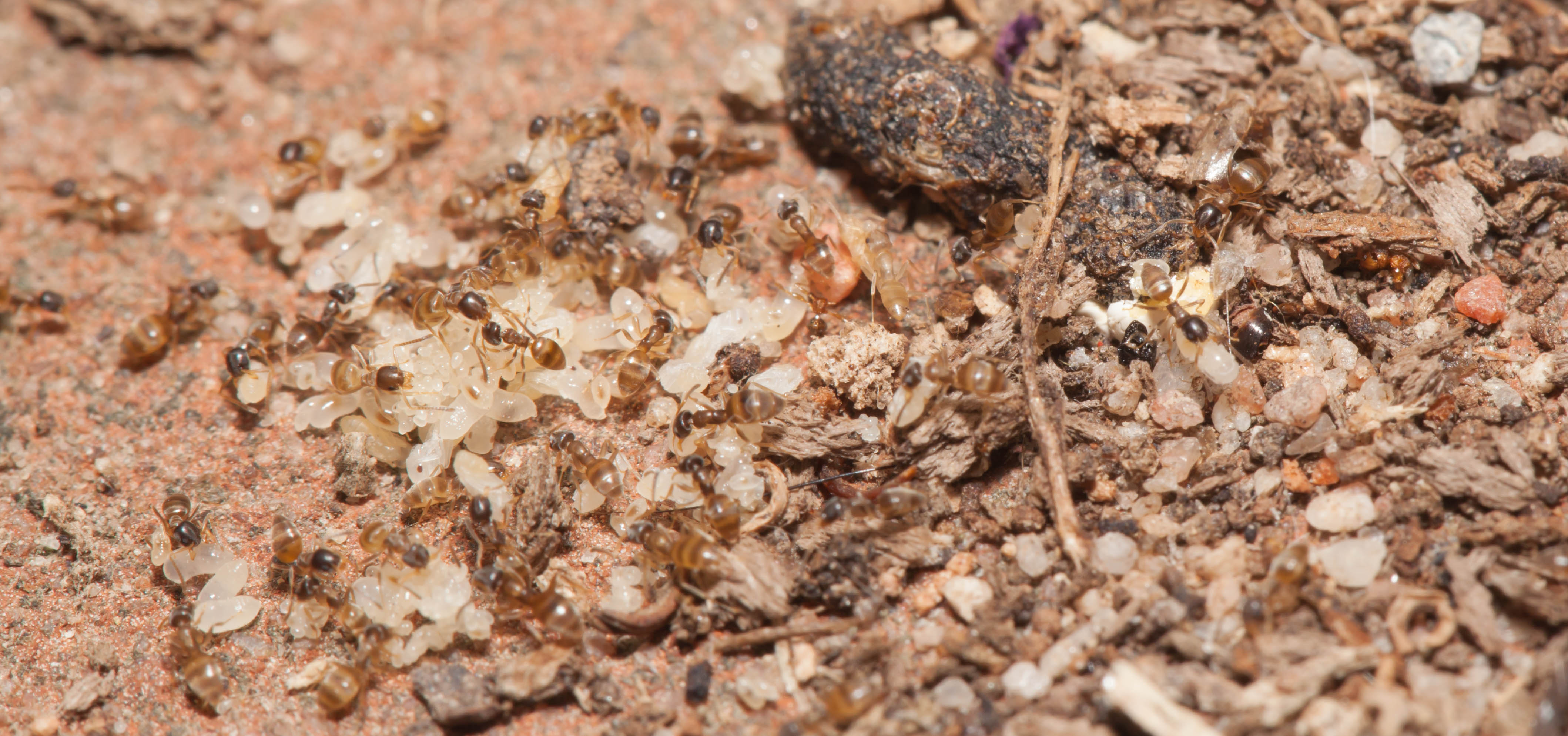
Ghost ants are among Florida's smallest pest ant species — adults are typically 1/16 inch or slightly smaller in length. The most distinctive feature is the two-toned coloration: the head and thorax are dark brown (nearly black), while the abdomen and legs are pale yellow to almost completely transparent, appearing whitish or translucent under normal lighting. On white or light-colored kitchen surfaces, the dark-headed, pale-bodied ant can be extremely difficult to see without close attention. Workers are all approximately the same small size — they are monomorphic, unlike fire ants or carpenter ants that produce workers of varied sizes. When crushed, ghost ants produce a faint coconut-like odor, a distinguishing feature of Tapinoma species that can help confirm identification when visual features are difficult to observe. Ghost ants move quickly along established pheromone trails, appearing as thin, fast-moving lines of nearly invisible tiny insects. Holding a flashlight at a low angle across a surface — countertops, baseboards, walls — makes active foraging trails significantly more visible by creating shadows from the moving ants.
Behavior & Habits
Ghost ants are polydomous — maintaining multiple sub-nests distributed across the landscape and through the structure simultaneously. Queens are numerous within the colony, with multiple reproductive females distributed across different sub-nests. This reproductive redundancy makes colony elimination much more challenging than for single-queen ant species, where finding and killing one queen collapses the colony. Outdoors, ghost ants nest in soil, under ground debris and leaf litter, in the cracks of paving stones, under pot liners, in the root zone of landscaping plants, and in the soil of outdoor plant containers. Indoors, they nest behind baseboards, inside wall voids near moisture sources, under flooring, inside hollow door frames, and in the soil of indoor potted plants. The same colony spans indoor and outdoor sub-nests simultaneously and continuously. Workers lay pheromone trails from nests to food sources and maintain these trails over extended periods. In kitchens, ghost ants are strongly attracted to sweets and sugary foods — honey, syrup, candy, spilled fruit juice — and to any liquid that has dried and left a sugary residue on surfaces. Ghost ants also tend aphids, mealybugs, and scale insects on houseplants, harvesting the honeydew these insects excrete. A heavily infested indoor plant can serve as a sustained, independent food source supporting large ghost ant foraging populations regardless of kitchen sanitation.
Prevention
Ghost ant prevention relies heavily on sanitation and moisture management. Store sugar, honey, syrup, and grain products in sealed airtight containers — not in their original packaging. Clean up food spills immediately, particularly liquids that dry and leave a sweet residue. Pay close attention to the area around and under the stove, toaster, and coffee maker, which accumulate food residue that ghost ants exploit. Run the garbage disposal with running water to flush organic material from drain lines. Address moisture under sinks and in bathrooms. Ghost ants are strongly attracted to water and congregate around leaking pipes, dripping faucets, and persistently wet areas under sink cabinets. Fix plumbing leaks promptly and use ventilation in bathroom vanities that accumulate humidity. Inspect indoor plants regularly for aphids, mealybugs, and scale insects on leaves and stems. Infested plants indoors serve as a ghost ant food source independent of kitchen management — controlling sap-feeding plant pests removes one of the key attractants. Seal gaps at baseboards in kitchens and bathrooms, around pipe penetrations under sinks, and around the base of the toilet — these are primary entry points and preferred nesting sites. Keep outdoor mulch beds thin and pulled away from the foundation, as ghost ants nest readily in moist mulch and routinely transition between outdoor and indoor sub-nests through foundation gaps.
Professional Treatment
Ghost ants require non-repellent gel bait rather than spray insecticides. Gel bait is placed in small amounts directly on active foraging trails and at entry points. Workers consume the bait and carry it back through the foraging network to the colony, where it is shared with queens and other workers across multiple sub-nests. Because the active ingredient moves through the colony's food-sharing network, it reaches queens that would otherwise be protected deep in wall voids or outdoor nesting sites. The most critical rule of ghost ant baiting: do not apply any repellent insecticide spray simultaneously or recently before baiting. Repellent sprays — including nearly all consumer ant spray products — interrupt foraging trails and cause the colony to fragment and disperse to new locations, preventing workers from finding and consuming bait. Any spraying near active ghost ant trails will undermine a baiting program and spread the infestation further. Results from baiting take 1 to 4 weeks as the active ingredient distributes through the multi-nest colony network. Multiple bait placements and follow-up applications are typically needed for established infestations. Professional treatments use bait formulations not available to consumers and map the full colony distribution to ensure complete coverage. GreenCore Environmental treats ghost ant infestations throughout Central Florida. Call (866) 816-BUGS to schedule an inspection.
Why Professional Treatment Matters
Ghost ants (Tapinoma melanocephalum) are one of the most challenging ant species in Florida because of their colony structure: ghost ant colonies are polygyne (multiple queens) and polydomous (spread across multiple nest sites), meaning eliminating one nest site has minimal effect on the overall population. Consumer contact sprays kill foraging workers on contact but trigger a stress response in the colony called budding — the queens and remaining workers split and relocate to form new satellite colonies elsewhere in the structure. Ghost ants are trail ants that follow moisture and food into kitchens, bathrooms, and electrical outlets. In multi-unit buildings, they move freely through shared walls and utility chases. Because each colony may have dozens of queens distributed across multiple sites, professional treatment using transfer-effect baits is the only reliable elimination method.
GreenCore Covers Ghost Ant
GreenCore treats ghost ant infestations using slow-acting gel bait that foraging workers carry back to the colony and share with queens and larvae through trophallaxis — the process of food sharing that allows the active ingredient to spread throughout the entire colony network. Bait is placed at trail intercept points along baseboards, under appliances, and at moisture sources where ghost ants concentrate. Contact sprays are avoided because they trigger colony dispersal. For exterior entry control, a perimeter liquid treatment is applied to prevent new colonies from trailing in from landscaping. Ghost ant infestations often require two service visits to achieve full elimination of all satellite colony sites.
The GreenCore Guarantee
If you see pest activity between your scheduled service visits, call us. We will return and re-treat at absolutely no additional charge. This guarantee is not a marketing statement — it is built into every plan we offer. We stand behind our work because we are confident in our methods, and we believe that paying for pest control should mean your pest problem is actually solved.
Dealing with Ghost Ant?
Contact GreenCore Environmental to schedule a free inspection. Our licensed technicians serve Central Florida homes and businesses throughout Orange, Osceola, Polk, and Seminole counties.