
German Cockroach
Blattella germanica
Identification, behavior, health risks, prevention, and professional treatment options for Central Florida residents.
Overview
The German cockroach is widely considered the most difficult cockroach species to control in the world — and in Florida homes, apartments, and restaurants, it is the most common cockroach causing serious infestations. Unlike the American cockroach, which primarily lives outdoors and migrates in, the German cockroach is an exclusively indoor species. It almost never survives outside in Florida's environment. Nearly every German cockroach found inside a structure arrived through human activity: in grocery bags, cardboard boxes, secondhand appliances, food deliveries, or luggage. This distinction fundamentally changes the nature of the problem. German cockroach infestations are not driven by a large outdoor population — they are self-sustaining indoor populations that grow from an initial introduction. And they grow extremely fast. A single mated female produces an egg case containing 30 to 40 eggs every 3 to 4 weeks, carrying it on her body until just before hatching. Under typical kitchen conditions, a population can complete three to four reproductive cycles per year. A single hitchhiking female introduced on a used appliance can seed an infestation of hundreds within a few months. **Health Concerns** German cockroaches contaminate food and kitchen surfaces with bacteria including Salmonella, Listeria, and E. coli. Their fecal droppings, shed exoskeletons, and egg case remnants contain potent allergen proteins. Research has established that German cockroach allergen exposure in early childhood significantly increases the risk of developing asthma, and that children with asthma living in infested homes experience more frequent and severe attacks than those in clean homes. In commercial food service, large German cockroach infestations produce a musty, oily odor from aggregation pheromones the insects excrete. Health inspectors treat this odor as presumptive evidence of infestation and it is grounds for closure violations. **Why They Spread So Quickly and Resist Treatment** German cockroaches have developed resistance to many commonly used insecticides. Populations repeatedly exposed to the same active ingredient develop metabolic pathways that neutralize it. Consumer spray products — most of which use repellent pyrethroids — tend to make German cockroach infestations worse. They drive cockroaches deeper into wall voids and spread them throughout the structure rather than eliminating the colony. In multi-unit housing, which makes up a large portion of Central Florida's residential stock, cockroaches move between units through shared plumbing and electrical conduits, making individual unit treatment ineffective without building-wide coordination.
Appearance
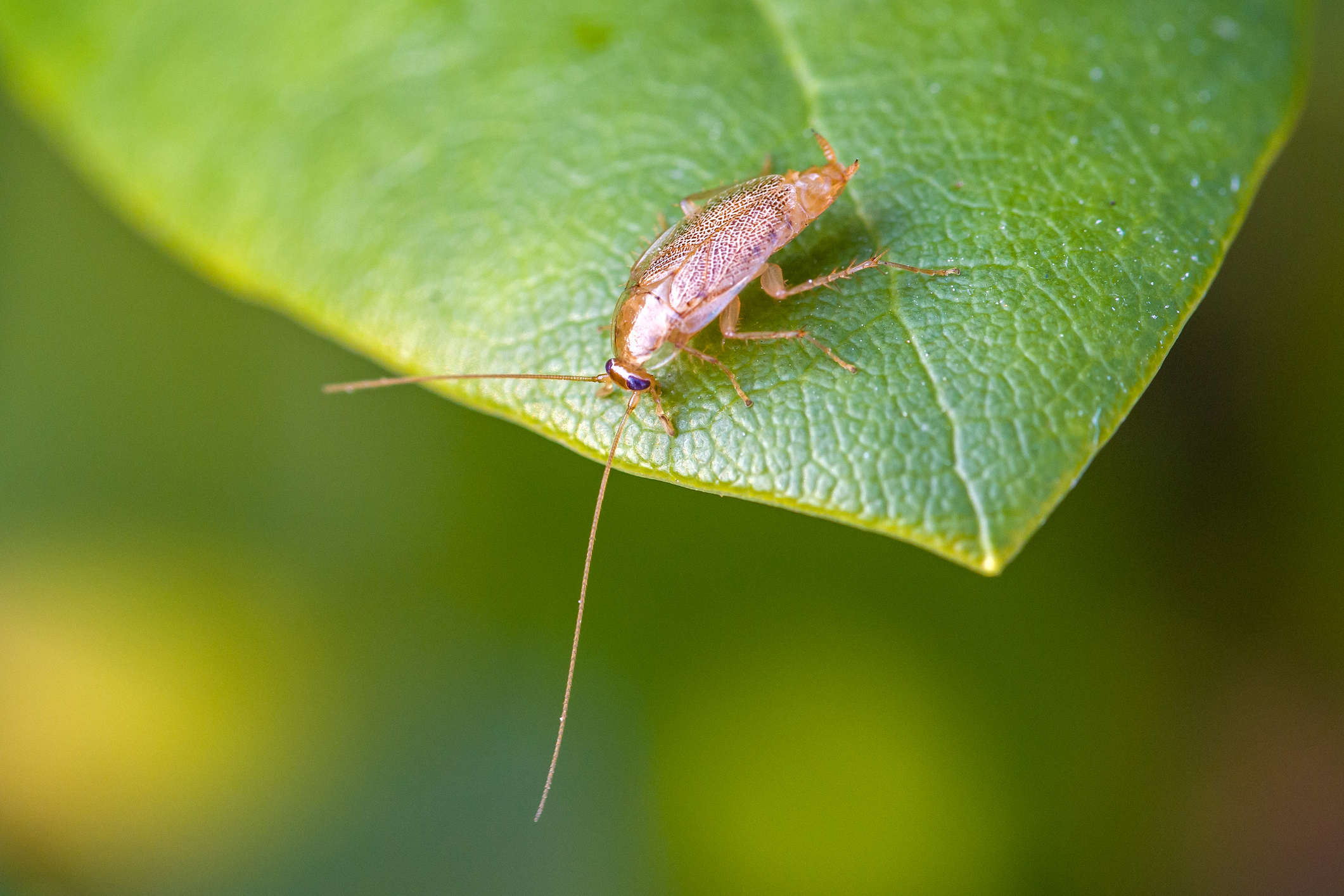
German cockroaches are small — adults measure only ½ to ⅝ inch in length — but they are distinctive once identified. The body is light tan to medium brown with two dark, parallel stripes running from just behind the head to the base of the wings. These parallel stripes are the most reliable identification feature: no other common Florida cockroach has this marking. Despite being fully winged, German cockroaches almost never fly under natural conditions. Adults of both sexes have well-developed wings that lay flat across the abdomen, but flight is not typical behavior. The antennae are long, roughly equal to body length. Nymphs are darker than adults — nearly black immediately after hatching — and lighten progressively through six molts as they develop wing pads. The two dark stripes are visible even in early-instar nymphs, making identification possible at small size. Egg cases (oothecae) are tan, rectangular capsules approximately ¼ inch long, typically wedged into the interior hinges of kitchen cabinets or inside the motor compartment of appliances.
Behavior & Habits
German cockroaches are exclusively indoor insects in Florida, spending their entire lives inside structures. They thrive in warm, humid environments with access to food and water — making kitchens and bathrooms their ideal habitat. They aggregate in tight harborage sites in the warmest zones near food and water: motor compartments of refrigerators and dishwashers, beneath and behind microwave ovens, inside cabinet hinges, around water heater connections, behind wall switch plates, and in hollow equipment frames. These warm, protected cavities are where egg cases are deposited and where the bulk of the population concentrates. German cockroaches are most active after dark. Seeing them during daylight is a reliable indicator of a large, overcrowded population — when harborage space cannot accommodate the population size, individuals are forced into the open during daylight hours. They feed on starch, sugar, grease, and fermenting organic matter. In kitchens, they exploit food residue in drains, crumbs under appliances, grease in oven crevices, and organic buildup in garbage disposals. When preferred foods are unavailable they will consume soap residue, toothpaste, and paper.
Prevention
German cockroach prevention is primarily about sanitation and controlling what enters the home. Clean kitchen appliances regularly — the area beneath and behind the stove, drip trays under burners, and the interior of the microwave. Run the garbage disposal with running water to flush organic residue from drain pipes. Store pantry food in sealed airtight containers; cardboard boxes and paper bags offer no barrier against cockroach intrusion. Be careful about what enters your home. Inspect cardboard boxes — grocery boxes and delivery packaging are common introduction vectors — before bringing them into the kitchen. Check secondhand appliances for signs of cockroach activity: dark fecal spotting along edges, egg cases in crevices, or a musty oily odor before bringing them indoors. Seal gaps around plumbing under sinks, pipe penetrations through cabinet floors, and baseboards in kitchens and bathrooms. These gaps are both harborage sites and travel corridors for German cockroaches. Reducing clutter — particularly stacks of paper, cardboard, and bags — eliminates harborage options where cockroaches hide between foraging trips. In apartments and multi-unit buildings, your personal sanitation reduces the local population but cannot prevent entry from neighboring units through shared walls and plumbing. Building-wide treatment is the only effective approach for shared-wall infestations.
Professional Treatment
German cockroach control requires a targeted professional approach because consumer products are largely ineffective against resistant populations and typically worsen infestations by causing dispersal. Professional treatment centers on gel bait applied directly in harborage sites — motor compartments, inside cabinets, under appliances — combined with Insect Growth Regulators (IGRs) that prevent nymphs from maturing into reproductive adults. Gel bait works because cockroaches consume it and carry it back to harborage where it contacts additional colony members. IGRs break the reproductive cycle by disrupting molting, eliminating future generations even after initial knockdown. Multiple treatment visits over 4 to 8 weeks are typically required for an established infestation, since egg cases are not killed by insecticides and new nymphs continue hatching between visits. German cockroach infestations do not resolve on their own and become harder to control as populations grow. Early professional treatment produces faster, more complete results. GreenCore Environmental treats German cockroach infestations across Central Florida — call (866) 816-BUGS to schedule an inspection.
Why Professional Treatment Matters
German cockroaches (Blattella germanica) are the most difficult cockroach species to eliminate because of their reproductive speed and genetic resistance to insecticides. A single female and her offspring can produce more than 30,000 descendants in one year. More critically, German cockroach populations that have been repeatedly exposed to pyrethroid insecticides — the active ingredient in most consumer sprays — have developed documented behavioral and metabolic resistance. Spraying an infested kitchen with a consumer product often disperses the population into wall voids and adjacent units without eliminating it. German cockroaches are almost exclusively an indoor species, living inside kitchens, bathrooms, and appliance voids. They contaminate food preparation surfaces with pathogens linked to Salmonella and E. coli and can trigger asthma attacks through their shed cuticles and fecal matter. Because infestations live inside the structure, professional treatment with access to harborage voids and rotation of active ingredients is required to overcome resistance and achieve elimination.
GreenCore Covers German Cockroach
GreenCore technicians treat German cockroach infestations using an Integrated Pest Management (IPM) protocol designed to overcome insecticide resistance. Gel bait is placed inside appliance voids, cabinet hinges, and wall-to-floor junctions — the exact harborage points consumer sprays never reach. GreenCore rotates bait active ingredients between service visits to prevent resistance development. Crack-and-crevice residual treatment is applied to secondary harborage areas. For multi-unit structures, GreenCore assesses adjacent units to identify cross-unit spread. German cockroach infestations typically require two to three service visits to achieve full elimination, and GreenCore's guarantee covers re-treatment at no additional charge if activity persists.
The GreenCore Guarantee
If you see pest activity between your scheduled service visits, call us. We will return and re-treat at absolutely no additional charge. This guarantee is not a marketing statement — it is built into every plan we offer. We stand behind our work because we are confident in our methods, and we believe that paying for pest control should mean your pest problem is actually solved.
Dealing with German Cockroach?
Contact GreenCore Environmental to schedule a free inspection. Our licensed technicians serve Central Florida homes and businesses throughout Orange, Osceola, Polk, and Seminole counties.