
Red Imported Fire Ant
Solenopsis invicta
Identification, behavior, health risks, prevention, and professional treatment options for Central Florida residents.
Overview
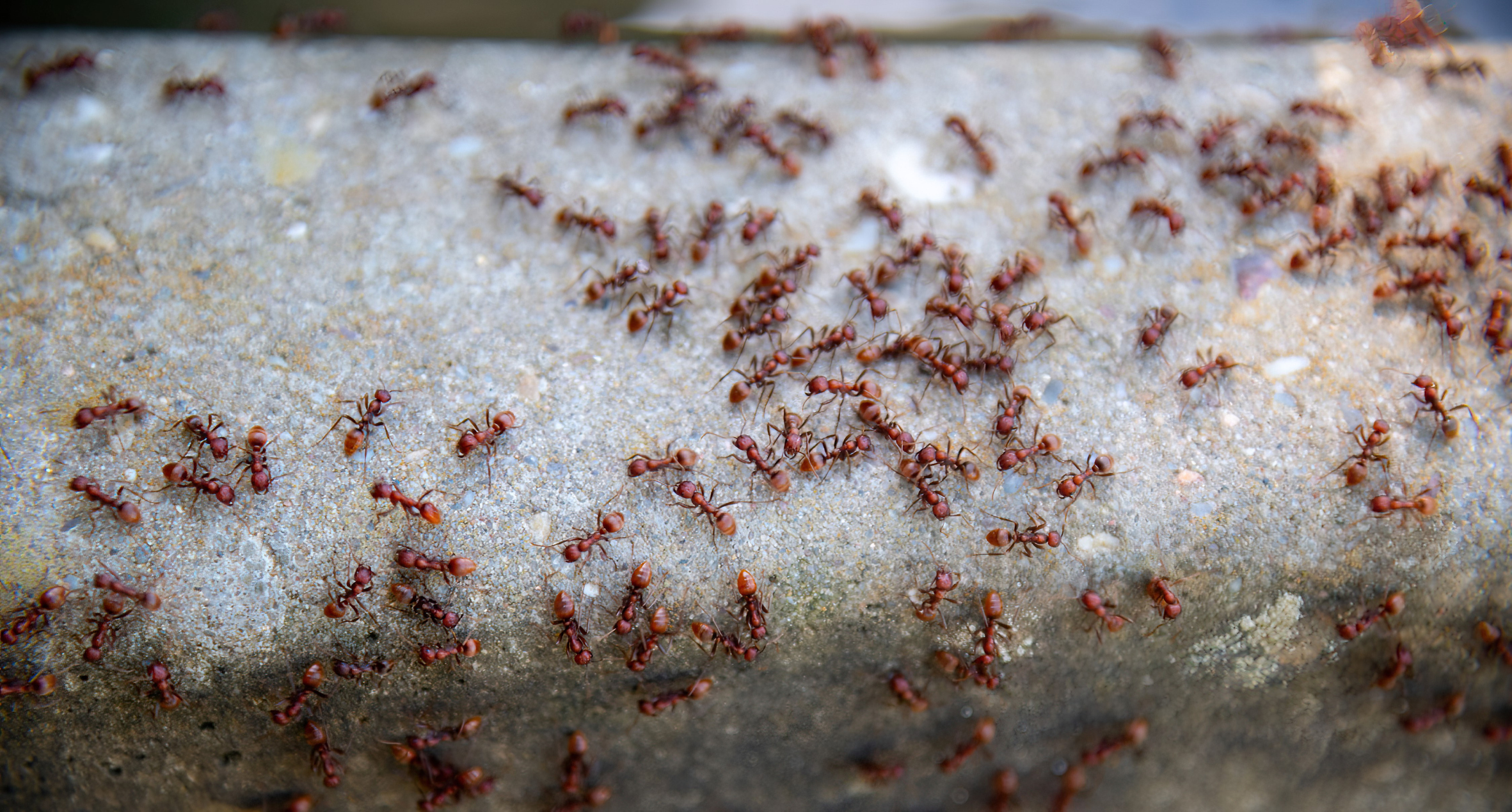
The Red Imported Fire Ant is one of the most consequential invasive pest species in the United States — and Florida is one of its primary strongholds. Introduced in the 1930s through soil in ship ballast at Mobile, Alabama, Solenopsis invicta has since spread across the entire Southeast, Puerto Rico, and other warm-climate regions. Today it is established in all 67 Florida counties, with some of the highest colony densities in the nation found in Central Florida's residential areas, parks, recreational fields, and golf courses. Fire ants present a combination of public health risks, property concerns, and ecological impacts that make them among the most consequential pest species in the state. Their aggressive defense behavior — swarming from disturbed mounds and delivering repeated stings within seconds — makes them a genuine hazard for anyone who uses outdoor spaces in Florida. **The Health Risk** Fire ant stings deliver venom containing alkaloids called solenopsins, producing an immediate burning sensation followed by a distinctive white pustule at the sting site within 24 hours. Most people experience localized reactions — pain, itching, and pustule formation — that resolve within a week without medical intervention. However, approximately 1 to 2 percent of people who are stung develop systemic allergic reactions that can progress to anaphylaxis, which is life-threatening and requires immediate emergency medical treatment. In the United States, fire ants are associated with an estimated 5 million stings per year requiring medical attention. People with mobility limitations — the elderly, infants, and outdoor workers — are at elevated risk of receiving mass stings before they can move away from a disturbed mound. Small pets and young wildlife can receive fatal sting attacks when unable to escape. **Property and Infrastructure Impacts** Fire ants are attracted to electrical equipment and cause significant property damage. They infest junction boxes, air conditioning compressor units, traffic signal controls, utility pedestals, and electrical service panels — nesting inside equipment and causing short circuits and equipment failures. Fire ant damage to electrical infrastructure costs Florida property owners and utilities millions of dollars annually. They also damage irrigation system components, undermine paving stones and concrete, and make lawn mowing hazardous.
Appearance
Red imported fire ants are reddish-brown to reddish-black, with workers ranging from 1/16 to ¼ inch in length. Colonies produce workers of multiple sizes — minor workers for small tasks and travel through fine tunnels, and major workers ("soldiers") with larger heads for processing bigger prey and food items. This polymorphism (multiple worker sizes within one colony) helps distinguish imported fire ants from many other ant species. The most reliable identification feature is the mound. Fire ant mounds are dome-shaped, constructed of loosely textured, fluffy soil, and have no visible entrance hole at the top — unlike most native ant species. Mounds can reach 18 inches or more in height and 18 to 24 inches in diameter in undisturbed areas; in regularly mowed lawns they are lower and flatter but retain the dome shape. Behavioral identification: when a mound is lightly disturbed, hundreds of fire ants boil out in an aggressive swarm within seconds, moving rapidly upward and outward and immediately beginning to sting. This explosive defensive response is distinctive and clearly separates Red Imported Fire Ants from Florida's less aggressive native ant species.
Behavior & Habits
Fire ant colonies are founded by a single mated queen but frequently become polygyne in Florida — containing multiple reproductive queens. Polygyne colonies are less territorial, allowing workers from different mounds to intermingle and enabling new colonies to bud off from existing ones. This is a key driver of the very high colony densities observed in Central Florida, where multiple mounds can be found within just a few feet of each other in undisturbed turf. A mature single-queen colony contains 100,000 to 250,000 workers; polygyne colonies can exceed 500,000. Workers respond explosively to mound disturbance — swarming upward within seconds and stinging immediately and repeatedly. A person who steps on or near a mound may receive dozens of stings before realizing what has happened. Fire ants forage aggressively across a 50 to 100-foot radius from the mound, feeding on a wide range of food sources: insects, earthworms, carrion, seeds, fruit, and small vertebrates too slow to escape. They actively prey on ground-nesting birds, lizards, and small mammals, making them one of the most ecologically disruptive invasive species in Florida's native wildlife communities. New colony establishment occurs through mating flights — queens fly up to a mile from their natal colony, mate in the air, land, and begin a new colony. Mating flights are triggered by warm temperatures following rain events, which is why new mounds seem to appear suddenly throughout Central Florida neighborhoods after summer storms.
Prevention
Complete elimination of fire ants from a Central Florida yard is unrealistic given the surrounding population density — new colonies will establish from neighboring properties regardless of what is done on your lot. Realistic goals are population suppression and mound density reduction in regularly used outdoor areas. Keep turf mowed and vegetation trimmed. Tall grass and dense ground cover provide shelter and make mounds harder to detect before they are accidentally disturbed. Inspect children's play areas, sandboxes, outdoor seating areas, and sports fields before use — mounds can establish quickly and small mounds are easy to miss in grass. Check air conditioning units, irrigation valve boxes, utility pedestals, and electrical service panels at least annually, as fire ants preferentially nest in these locations. Avoid disturbing mounds without immediately treating them. An untreated disturbed mound does not disappear — the colony rebuilds within days, sometimes at an adjacent location. Incomplete treatments that kill workers but not queens result in mound relocation rather than colony elimination. DIY bait or contact products applied incorrectly can have this result. Ongoing management rather than one-time elimination is the realistic expectation for Central Florida properties.
Professional Treatment
Fire ant management in Florida typically uses broadcast bait treatments across the entire treated area, individual mound treatments for locations requiring faster action, or a combination of both. Broadcast baits use protein or oil-based carriers containing slow-acting insecticides that foraging workers collect and carry back to the colony, distributing the active ingredient to queens and brood. Results appear over 4 to 8 weeks but achieve broad, colony-wide population reduction including the reproductive caste. Individual mound treatments — contact insecticide drenches or granular products — act faster on specific mounds in high-traffic areas but do not address the broader yard population. Professional programs often combine both approaches for comprehensive control. The critical factor is queen elimination. Any treatment that kills workers while leaving queens intact allows the colony to fully recover within weeks. Professional-grade bait formulations are significantly more effective than consumer products at achieving queen kill through the colony's food-sharing network. Twice-annual retreatment is standard practice in Central Florida due to continuous reinfestation from surrounding areas. GreenCore Environmental provides fire ant management throughout Orange, Osceola, Polk, and Seminole counties — call (866) 816-BUGS for a property assessment.
Why Professional Treatment Matters
Red Imported Fire Ants (Solenopsis invicta) are an invasive species in Florida with no effective natural predators, and consumer mound treatments address only the visible portion of what can be a colony of 200,000 to 500,000 workers. Pouring boiling water or applying granular consumer products over a mound kills surface workers but rarely reaches the queen, who may be located 3 to 6 feet below grade. Without queen elimination, the colony relocates and re-establishes within days. Fire ant stings deliver venom that causes a distinctive burning sensation and can trigger severe allergic reactions in sensitized individuals. Children, the elderly, and pets face serious risk from mound disturbance. Yards, schoolgrounds, athletic fields, and landscaped commercial properties with active fire ant pressure require a systematic treatment program — not reactive mound treatments after incidents occur.
GreenCore Covers Red Imported Fire Ant
GreenCore treats fire ant pressure using a two-step approach: broadcast fire ant bait applied across the entire property to suppress the population, followed by targeted mound drench treatments on active colonies. Broadcast bait is carried back to queens by foraging workers, eliminating colonies throughout the yard — not just visible mounds. The two-step approach delivers substantially greater population reduction than mound-only treatments. Treatments are timed to foraging activity windows for maximum bait uptake. GreenCore recommends quarterly service for fire ant-prone properties and re-treats any new mound activity under the GreenCore Guarantee.
The GreenCore Guarantee
If you see pest activity between your scheduled service visits, call us. We will return and re-treat at absolutely no additional charge. This guarantee is not a marketing statement — it is built into every plan we offer. We stand behind our work because we are confident in our methods, and we believe that paying for pest control should mean your pest problem is actually solved.
Dealing with Red Imported Fire Ant?
Contact GreenCore Environmental to schedule a free inspection. Our licensed technicians serve Central Florida homes and businesses throughout Orange, Osceola, Polk, and Seminole counties.