
Earwigs
Forficula auricularia
Identification, behavior, health risks, prevention, and professional treatment options for Central Florida residents.
Overview
Earwigs are one of Florida's most misunderstood occasional-invader pests. Despite their alarming appearance — the prominent rear pincers give earwigs a fearsome look disproportionate to their actual threat — they pose no meaningful threat to humans. The European earwig (Forficula auricularia) and the ring-legged earwig (Euborellia annulipes) are the most common species encountered in Central Florida. They are outdoor insects that become indoor pests when conditions outside become inhospitable — heavy rain, drought, or very hot dry spells drive earwigs to seek shelter along the foundation and inside structures through gaps under doors and around plumbing. Earwigs are primarily nocturnal omnivores. Outdoors they play a mixed role — consuming decaying organic matter and soft-bodied insects while also feeding on seedlings and flower petals. The presence of large numbers of earwigs around a structure almost always indicates moist, decaying organic material nearby: heavily mulched beds, wet leaf litter against the foundation, or moisture-retaining debris along building perimeters.
Appearance
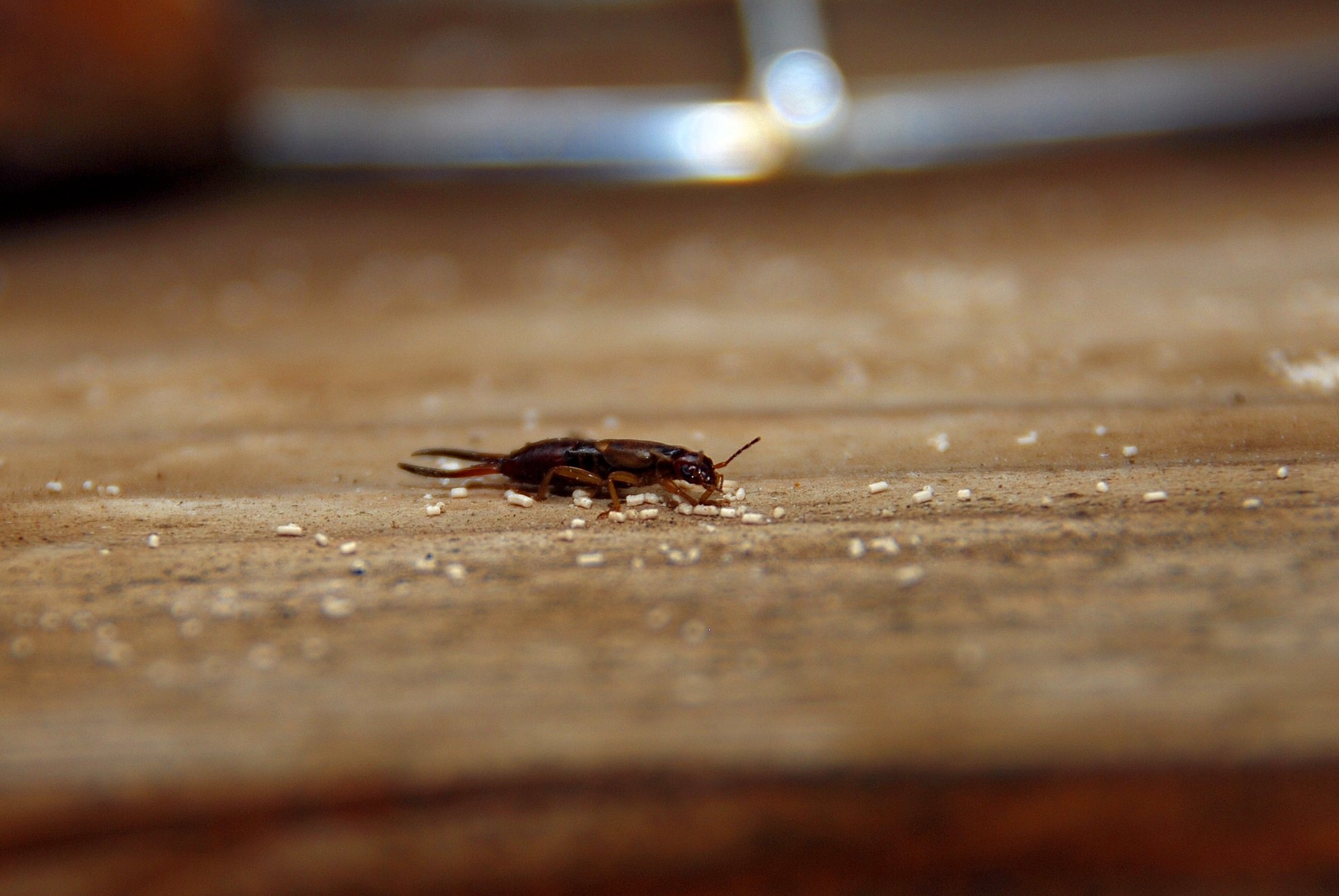
Adult earwigs are 5/8 to 3/4 inch long, elongated, and dark reddish-brown to black. The most distinctive feature is the pair of curved, hardened pincers (cerci) projecting from the rear of the abdomen, used for defense, prey capture, and mate competition. Males have curved, asymmetrical pincers; females' pincers are more straight. Earwigs have a pair of wings tucked beneath short, leathery wing covers, though they rarely fly. Long, bead-like antennae and six legs complete the profile. Despite their menacing appearance, the pincers cannot penetrate human skin effectively.
Behavior & Habits
Earwigs are strongly thigmotactic — they seek tight spaces with contact pressure on multiple body surfaces simultaneously — which is why they are found in folded newspapers, under flower pots, beneath bark, in woodpile gaps, and in mulch. At night they forage actively; during the day they shelter in the tightest harborage available. They are attracted to outdoor lights and accumulate under porch lights on warm evenings. Female earwigs exhibit unusual maternal behavior, guarding egg clusters until they hatch.
Prevention
Reduce moist, organic harborage adjacent to the foundation: pull mulch back at least 12 inches from the structure, remove leaf litter accumulations, and eliminate wood piles or stored materials in direct contact with the foundation. Fix drainage issues that create persistently moist soil along the building perimeter. Seal door sweeps and gaps around plumbing penetrations. Reduce outdoor lighting intensity or switch to yellow spectrum lighting that attracts fewer insects.
Professional Treatment
Earwig management typically requires only exterior treatment — residual insecticide applied along the foundation perimeter, under leaf litter, in mulch beds, and around entry points. Interior earwig treatment is rarely necessary. For persistent invasions, a moisture audit of perimeter conditions driving earwig concentrations is more productive than repeated interior treatments. GreenCore Environmental addresses earwigs as part of standard perimeter pest control. Call (866) 816-BUGS.
Why Professional Treatment Matters
Earwigs (Forficula and Euborellia species) are outdoor moisture insects that invade Florida homes during heavy rains, seeking shelter in garages, bathrooms, and basement areas. Consumer perimeter sprays provide short-term contact kill but do not address the outdoor population breeding in mulched landscaping beds, leaf litter, and decaying organic material immediately adjacent to the structure. After the spray residual dissipates — typically within days of rainfall — earwigs resume their migration indoors. While earwigs are not dangerous, large invasion events are alarming and indicate a breeding population in the surrounding landscape that is not being addressed. Professional treatment targets both the entry points and the outdoor breeding environment, providing longer-lasting control than consumer perimeter sprays.
GreenCore Covers Earwigs
GreenCore's earwig service applies residual granular and liquid treatment to the landscape beds, mulch, and leaf litter immediately surrounding the structure — the primary outdoor breeding environment for earwigs. A perimeter liquid treatment is applied to the foundation, expansion joints, and lower wall surfaces at all potential entry points. Interior treatment targets entry-point areas in garages, utility rooms, and bathrooms. GreenCore recommends pulling mulch back from the foundation edge and removing excessive organic debris to reduce earwig harborage. Earwig control is included as part of GreenCore's General Pest Control program and is covered under recurring service plans.
The GreenCore Guarantee
If you see pest activity between your scheduled service visits, call us. We will return and re-treat at absolutely no additional charge. This guarantee is not a marketing statement — it is built into every plan we offer. We stand behind our work because we are confident in our methods, and we believe that paying for pest control should mean your pest problem is actually solved.
Dealing with Earwigs?
Contact GreenCore Environmental to schedule a free inspection. Our licensed technicians serve Central Florida homes and businesses throughout Orange, Osceola, Polk, and Seminole counties.