
Centipedes & Millipedes
Scutigera coleoptrata / Trigoniulus corallinus
Identification, behavior, health risks, prevention, and professional treatment options for Central Florida residents.
Overview
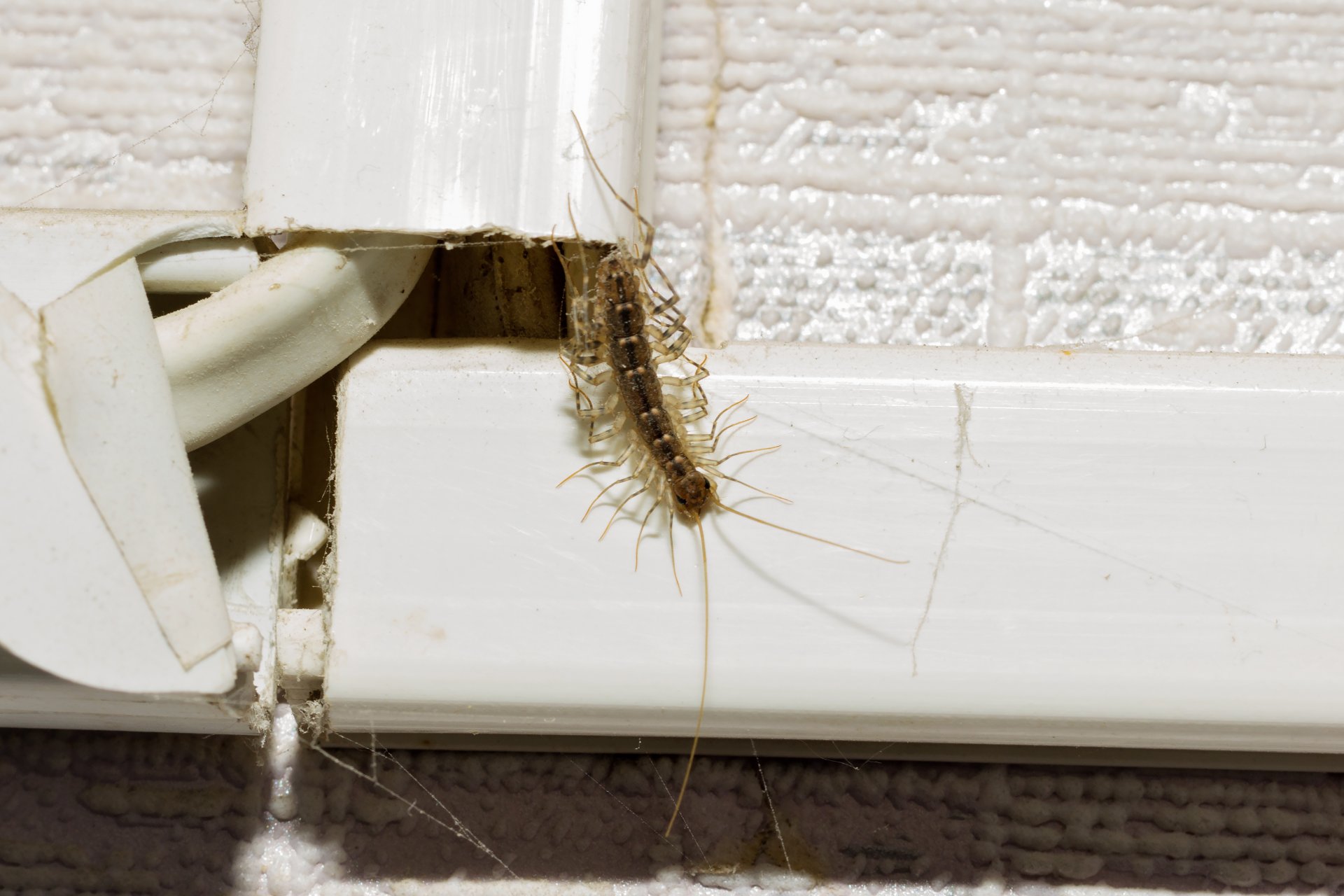
Centipedes and millipedes are frequent occasional invaders in Central Florida homes. House centipedes (Scutigera coleoptrata) and Florida blue centipedes (Hemiscolopendra marginata) are the species most commonly encountered indoors — both are predators that consume insects, spiders, and other arthropods. Millipedes — primarily the rusty millipede (Trigoniulus corallinus) and flat-backed millipede species (Polydesmida) — are detritivores that feed on decaying organic material and are not predatory. Both groups become indoor pests when outdoor conditions such as flooding, drought, or habitat disturbance drive them toward structures. Central Florida's heavy rainfall, abundant leaf litter, and moist soil conditions support high populations of both groups in garden and landscape environments. Mass millipede migration events — often occurring after heavy rain saturates soil — can deliver hundreds of individuals to a structure's foundation within a short period.
Appearance
House centipedes are distinctive and startling: up to 1½ inches long with 15 pairs of very long, striped legs extending far beyond the body. They are tan-gray with darker banding and move very rapidly. Florida blue centipedes are flatter, up to 4 inches long, and have bright blue legs on a dark body — they can deliver a mildly venomous bite if handled. Millipedes are worm-like, cylindrical (round cross-section distinguishes them from the flatter centipedes), slow-moving, and have two pairs of legs per body segment versus centipedes' one pair per segment. Rusty millipedes are approximately 1 inch, dark reddish-brown to black with orange-red lateral stripes. When disturbed, millipedes curl into a protective coil.
Behavior & Habits
House centipedes are moisture-seeking nocturnal predators that pursue pest insects; their presence in high numbers indoors indicates an abundant indoor prey population. Millipedes are outdoor creatures almost exclusively — they enter structures accidentally rather than by preference and typically die within a day or two indoors from desiccation. Millipede migrations tend to be seasonal and event-driven, most commonly occurring in the days immediately following heavy rainfall.
Prevention
Reduce moist organic harborage at the foundation — leaf litter, wet mulch, wood debris, and decaying plant material. Seal foundation cracks, door sweep gaps, and utility penetrations. Address any moisture or drainage issues that keep perimeter soil perpetually wet. Reduce indoor prey insects, as centipedes follow their food source indoors. Stack firewood away from the structure and off the ground.
Professional Treatment
Centipede and millipede management requires exterior perimeter treatment with residual insecticide applied to the foundation wall, soil band, mulch beds, and entry points, combined with habitat modification to remove the moist organic conditions supporting populations adjacent to the structure. Interior centipede activity is most effectively addressed by treating the indoor pest population that centipedes are feeding on. GreenCore Environmental can help against centipede and millipede invasions. Call (866) 816-BUGS.
Why Professional Treatment Matters
Centipedes and millipedes in Florida are moisture-dependent arthropods that invade homes during wet weather and when outdoor conditions become too dry. Florida's house centipede (Scutigera coleoptrata) and the giant Scolopendra species are venomous and capable of producing a painful bite, while millipedes are non-venomous but produce defensive secretions that can irritate skin and stain surfaces. Consumer sprays kill individuals on contact but do not address the outdoor population in leaf litter, mulch, and landscaping where these arthropods breed. Large-scale invasion events — hundreds of millipedes entering a garage or ground floor — indicate a population explosion in the surrounding landscape, typically following a period of heavy rain. Professional treatment addresses the outdoor breeding environment and creates a perimeter barrier that prevents mass migration events.
GreenCore Covers Centipedes & Millipedes
GreenCore helps protect against centipede and millipede invasions by applying granular treatment to landscape beds, mulch lines, and moist outdoor areas adjacent to the structure, combined with liquid perimeter treatment at the foundation and lower wall. For giant Scolopendra centipedes, targeted treatment of outdoor harborage areas — wood piles, decorative rock, and ground cover plants — is included. Interior treatment addresses entry point areas in garages and ground-floor perimeter. Habitat modification recommendations (reducing excessive mulch depth, correcting drainage) are provided to reduce ongoing harborage condition.
The GreenCore Guarantee
If you see pest activity between your scheduled service visits, call us. We will return and re-treat at absolutely no additional charge. This guarantee is not a marketing statement — it is built into every plan we offer. We stand behind our work because we are confident in our methods, and we believe that paying for pest control should mean your pest problem is actually solved.
Dealing with Centipedes & Millipedes?
Contact GreenCore Environmental to schedule a free inspection. Our licensed technicians serve Central Florida homes and businesses throughout Orange, Osceola, Polk, and Seminole counties.