
Carpenter Ants
Camponotus floridanus
Identification, behavior, health risks, prevention, and professional treatment options for Central Florida residents.
Overview
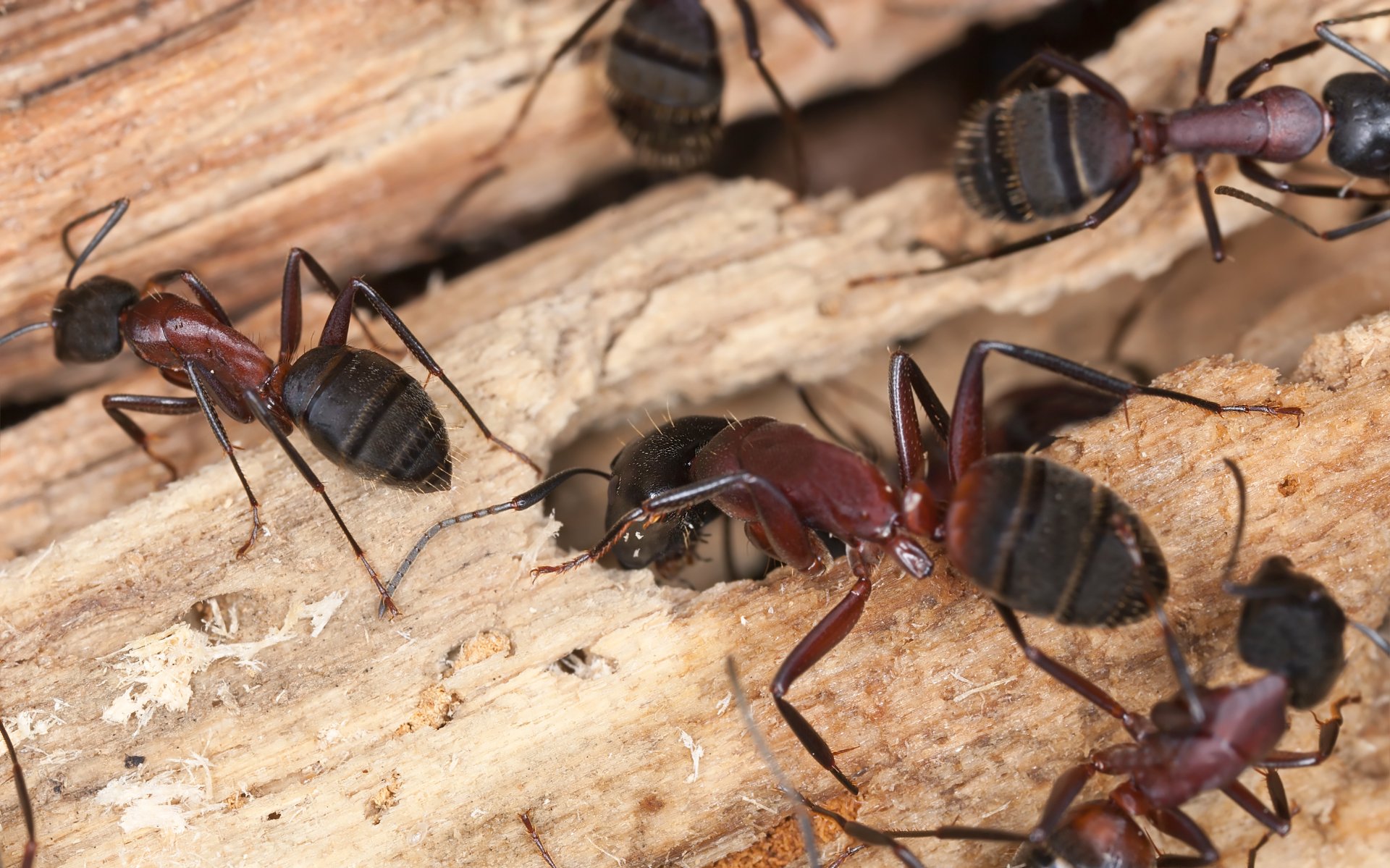
Florida carpenter ants — primarily Camponotus floridanus and Camponotus tortuganus — are among the largest ants found in Central Florida homes, and unlike small nuisance ants, they can cause meaningful structural damage. Carpenter ants do not eat wood; they excavate smooth galleries through soft or moisture-damaged wood to create nesting chambers. In Florida, they target wood that has been softened by water intrusion, fungal decay, or previous termite activity, making active or recent moisture problems the most reliable indicator of carpenter ant infestation in a structure. Carpenter ants are common in Central Florida's wooded residential neighborhoods and in homes bordered by trees, stumps, or organic debris. The parent colony almost always nests outside in a stump, log, dead tree limb, or landscape timber. Satellite colonies establish inside the structure when foragers discover a suitable cavity in moisture-softened wood — typically in wall voids near plumbing, roof eaves, window frames, or sub-floor supports with previous water damage.
Appearance
Florida carpenter ants are noticeably large — workers range from 5/16 to 1/2 inch in length, with major workers nearly twice the size of minor workers. Camponotus floridanus is bicolored: the head and thorax are red-orange to reddish-brown, and the gaster (abdomen) is black. They are often confused with fire ants by homeowners, but their significantly larger size and smooth, rounded thorax profile (fire ants have spines on the thorax) distinguish them clearly. Winged reproductive alates (swarmers) are produced seasonally and sometimes mistaken for termite swarmers; carpenter ant swarmers have elbowed antennae and wings of unequal length, while termite swarmers have straight antennae and equal-length wings.
Behavior & Habits
Carpenter ants are primarily nocturnal. Foragers travel 100–300 feet from their nest to find food — they are omnivores consuming insects, sweet liquids, and protein-based scraps — and return via established pheromone trails. Structural galleries are excavated with smooth, sandpaper-fine walls (as opposed to the mud-filled galleries of termites), and the ants push frass — a mixture of sawdust, soil, and insect fragments — out of the gallery in characteristic coarse piles. Finding frass piles inside a wall void or near a window frame is a strong indicator of active carpenter ant nesting.
Prevention
Address all moisture intrusion: repair roof leaks, fix plumbing leaks, regrade soil away from the foundation, and ensure gutters drain away from the structure. Remove wood-to-soil contact points — replace wood mulch near the foundation with stone or rubber mulch, remove dead stumps and logs from the property, and cut overhanging branches that provide a bridge to the roofline. Seal cracks, gaps, and penetrations at the foundation and roofline with appropriate materials.
Professional Treatment
Effective treatment requires locating and treating satellite nests inside the structure, treating the exterior perimeter with residual insecticides, and when possible identifying and eliminating outdoor parent colonies. Void injection into affected wall or structural voids kills satellite colonies and provides residual protection. Because carpenter ants almost always indicate moisture problems, repair of the underlying moisture damage is essential to preventing re-infestation. GreenCore Environmental provides targeted carpenter ant treatment and structural assessments. Call (866) 816-BUGS to schedule an inspection.
Why Professional Treatment Matters
Carpenter ants (Camponotus species) excavate wood to build galleries for nesting — they do not eat the wood, but the structural damage from extensive gallery networks can compromise structural integrity of framing, window sills, and door frames over time. Unlike termites, carpenter ants prefer wood that is already softened by moisture, which means a carpenter ant infestation is often an indicator of an underlying moisture or leak problem that also needs to be corrected. Consumer sprays kill foraging workers but do not penetrate the wall void or wood member where the colony is actually nesting. Carpenter ant queens are long-lived and produce workers steadily from protected nest sites. Only foam and dust injection directly into gallery networks, combined with exterior perimeter treatment, can reach and eliminate the colony.
GreenCore Covers Carpenter Ants
GreenCore technicians inspect exterior wood members, window and door frames, and any areas with past moisture damage to locate carpenter ant gallery entry holes (characterized by coarse sawdust frass). Insecticidal dust or foam is injected directly into gallery channels to reach the colony interior. Perimeter liquid treatment is applied to the foundation and lower exterior wall surfaces where foraging trails originate. GreenCore also notes and reports any moisture conditions that are contributing to wood softening, which the customer should address to prevent re-infestation. Follow-up inspection at 30 days confirms colony elimination.
The GreenCore Guarantee
If you see pest activity between your scheduled service visits, call us. We will return and re-treat at absolutely no additional charge. This guarantee is not a marketing statement — it is built into every plan we offer. We stand behind our work because we are confident in our methods, and we believe that paying for pest control should mean your pest problem is actually solved.
Dealing with Carpenter Ants?
Contact GreenCore Environmental to schedule a free inspection. Our licensed technicians serve Central Florida homes and businesses throughout Orange, Osceola, Polk, and Seminole counties.